
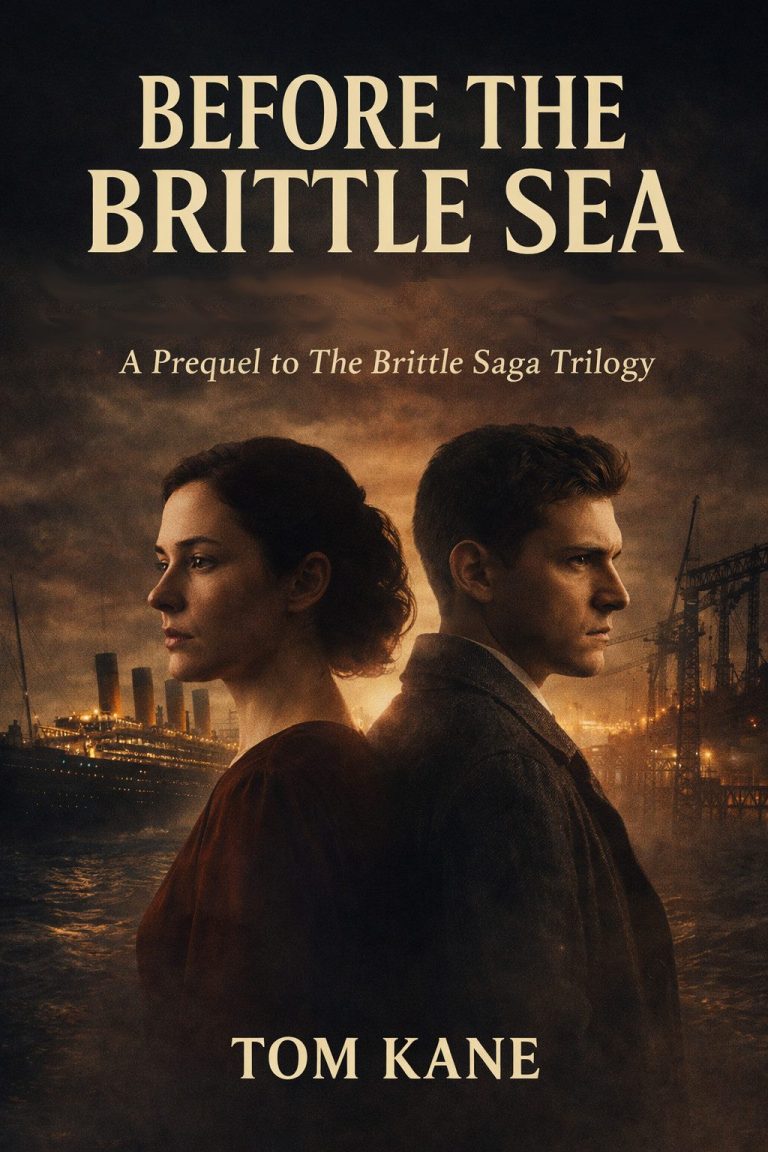
Book One: The Harker Affair
“ A man can’t build a future out of stolen iron. "
The Engineer from Nowhere
Hell’s Kitchen, New York City, Early 20th Century
Jack Billings was born into destitution and hate. His mother hated her life and hated her husband who had left her with child. And yes, she hated the child as well. She used to say the city made men the way foundries made steel, too hot, too fast, and full of cracks. She’d said it once, years ago, before the drink took hold. Before the young gangster, Jack, watched her die from a heart attack, without raising a finger to help.
“Better off out of this world, Ma,” he said when the coroner’s men took the body.
Jack learned that to survive in Hell’s Kitchen, you must take what was offered and what was not offered. They didn’t call it stealing, it was the opportunity to realign ownership. And to enforce that new ownership, fear was King in Hell’s Kitchen.
The Victorian notion that boys will be boys was never borne out in Hell’s Kitchen. Here men were created at an early age. If you were not looking after yourself and your family by the time a boy was ten years of age then Hell’s Kitchen made you a victim and that was your lot in life, fixed forever in your mind and you would never shake that belief.
The boy stood just four feet nothing in his dirty bare feet, but it was four feet nothing of pure defiance. Three elder boys all a good foot taller than the boy were doing their best to grab the small amount of money the boy clutched in his right hand. The same hand he was using to great effect as a weighted fist to slash out at the elder boys. The sharks were circling, determined on their course of action, their piece of the action, and the smaller boy knew it because he was weakening, even though he was giving these particular human sharks a lot of trouble for a few cents.
The few cents in question had been given to the boy by his sickly mother, sickly in that she craved another glass of booze, any booze, and the boy was on a determined errand to fulfil his mother’s ambition.
The boy had no father, all he had was his mother. No one to help him, no one to care, no one to even acknowledge his existence. But the boy had a few cents, his mother’s few cents, and those few cents would remain in his family, no matter what.
No words were spoken in this tableau, the same tableau that was played out over many times in as many days that were left in the short time span Hell’s Kitchen existed. But while it existed and boys like these in our tableau existed, then this scenario would be played out for any who cared to watch.
It was lucky, some say unlucky, for the smaller boy that someone had paid attention to his desperate desire to hang onto the few cents because as the sharks were seemingly getting braver and the upper hand, fate stepped in and a taller boy, a boy well on his way to being a teenager, if he survived, stepped in and with a kick, slap and another hefty kick he vanquished the sharks who fled the scene empty handed.
The small boy looked up in wonder and his tall hero and smiled. His smile quickly turned to despondency when the tall boy used the universal greeting of Hell’s Kitchen and held his hand out to the smaller boy.
“Don’t make me take it,” is all the older boy said.
The smaller boy knew he was bested and beaten, and he meekly handed over the money, head down in the universal sign of the vanquished.
“Hardly worth the trouble, but it helps.”
The smaller boy looked up.
“A piece of advice, boy. Get one of these and don’t be afraid to use it.” The tall boy was holding a gleaming blade, a shiv, a knife to you and me. A stiletto to be accurate, a weapon of power to the feral inhabitants of the kitchen.
The taller boy winked at his assailed victim, turned, and walked away.
The boy learned a lesson that day. To beat them at their own game, you need power in your hands, and you need to be clever, cunning, and of course ruthless. And it helps to make sure you have an alias on hand. Jack chose his wisely, he thought. William Harker sounded mean of mind and mean of heart and that would be his alias, his way to shirk responsibility.
By twenty, Jack had already lived through more winters than he cared to count. He’d grown up on a street, where the air smelt of coal dust and whiskey, and the Hudson lay just beyond the tenements, glinting like a blade. Every man in his building worked the docks or stole from them. The women washed, mended, and prayed in equal measure. And every night, the gangs went to war over crates, corners, and pride.
Jack wasn’t much of a fighter, but he was quick. He ran errands for the DeLuca crew, delivering messages, collecting small debts, sometimes carrying something that clinked in brown paper. He learned when to keep his mouth shut and when to smile. The trick, he’d discovered, was to look like you belonged to everyone and no one at once.
But what really set him apart was the way he watched the yards.
The White Star Line’s New York piers were the only clean things he’d ever seen, whitewashed sheds, tall cranes, ships so vast they blotted out the sun. He’d stand by the rail fence and watch the men fit cables and rivets, the air full of steam and shouts, and think it was the closest thing to heaven the city would ever build.
One foreman, an Englishman with a red face and a voice like a foghorn, caught him staring one afternoon.“You, boy,” the man barked. “You planning to work or pray?”
“Whichever pays better,” Jack said, and the man laughed.
By week’s end, he had his first steady job, sweeping floors in the repair shed. He learned fast. Within a month he could read the yard’s blueprints upside down. Within six, he was working the hoists, then the rivet guns. The other men said he had a head like an engineer, though the accent of a street rat.
When the whistle blew at night, Jack would walk alongside the river until the steam cleared from his lungs. Sometimes he passed the DeLuca boys drinking outside Salvatore’s, their laughter rough as gravel. They’d call out, “Hey, Jackie! You forgot where you come from?”
He hadn’t. He just didn’t plan on dying there.
***
It was in the spring when everything began to slide.
A cargo shipment vanished from the pier, two crates of copper wire bound for Liverpool. The boss blamed the unions, the unions blamed the Irish, and the Irish blamed everyone. Jack didn’t ask questions, but he heard whispers that the DeLuca gang had moved the goods upriver for resale.
That night, Rocco DeLuca himself came looking for him.
“Jackie,” Rocco said, draping a heavy arm across his shoulders. “You’re a clever lad. You know these ships, these men. We could use someone like you keeping an eye on the docks. Making sure the right crates go missing, the right ones don’t.”
Jack stared at the man’s diamond ring, bright as a bullet. “You want me to steal for you.”
“Not steal,” Rocco said with a smile. “Rearrange ownership. Everyone does it.”
“I’ve got a job,” Jack said.
“You’ve got a broom,” Rocco corrected. “I’m offering you a future.”
Jack looked away, toward the lights of a ship moored out on the black water, her funnels rising like towers against the dusk.
“I’ll think on it,” he said.
“Don’t think too long,” Rocco said. “Some offers rust.”
***
Two nights later, a fight broke out in the yards. Jack had stayed late, helping a fitter repair a boiler when he heard shouting by the warehouse. By the time he got there, three men were down, one of them bleeding badly from a knife wound. The others melted into the dark. Jack dropped to his knees beside the body and recognised him, Tommy DeLuca, Rocco’s youngest brother.
“Christ,” Jack whispered. “Who did this?”
Tommy’s lips moved, blood bubbling between his teeth. “You,” he managed to rasp. Then his eyes went flat.
Jack froze. Footsteps echoed down the pier, the watchmen, the police, someone. In the lamplight he saw the knife lying beside the corpse, its handle slick. He wiped his hands on his shirt and ran.
By morning, his name was being shouted from every street corner.
The police came first, then the gang. He hid in a warehouse by the docks, crouched behind crates of rope and drums of oil, listening to the city hunt him. The sun rose and fell, and when he finally dared to move, the only path left was the river.
***
At dawn, he slipped into the shipyard and found a freighter being loaded for Liverpool, the Ocean Monarch. He knew the quartermaster from the repair shed, a thick-necked man who owed him a favour.
“You didn’t see me,” Jack said, slipping two silver dollars into the man’s palm.
The quartermaster’s eyes flicked to the police patrol passing the gate, then back to Jack. “You’re a fool, boy. But a brave one. Down the hold. Don’t come out till we’re past the Narrows.”
Jack climbed aboard, the salt air cutting sharp in his lungs. As the ship pulled from the pier, he stood in the shadow of a lifeboat and watched the skyline sink behind him, the smokestacks, the spires, the cramped streets of Hell’s Kitchen fading into the haze.
He should have felt free. Instead, he felt hollow.
He whispered to the wind, “Jack Billings is gone.”
But even as he said it, he knew the city never let go. It just waited.
***
Three days into the voyage, a storm struck. The sea heaved and groaned, and Jack, crouched among the cargo, thought of the iron hulls he’d helped patch, the rivets hammered into place by men who swore each ship would last forever.
He smiled grimly. Nothing man-made lasted forever.
When the storm cleared, he climbed on deck at dawn. The horizon was clean and cold, the water turned to silver beneath a pale sky. Ahead lay Liverpool, a new world with old dangers.
He squared his shoulders, breathed the salt air, and said to himself, “Let’s see what an engineer from nowhere can build.”
The ship rolled on, eastward into the light.
Smoke and Steel
Liverpool, 1904
The smell of the Mersey hit Jack before he even saw it, a bitter mixture of coal smoke, wet rope and the metallic tang of rust that seemed to sit on the tongue. The river was wide and slow, a sluggish mirror of grey sky. Docks stretched as far as the eye could see, cranes like iron gallows, warehouses stacked high as tenement blocks.
Liverpool was what Hell’s Kitchen wanted to be: dirtier, louder, richer. Every man here seemed to carry a ledger or a bruised ego. Ships came and went with the tide, carrying goods and stories Jack had never dreamed of. For the first time in his life, he wasn’t running; he was adrift.
***
He found work within a week. The shipyards never asked many questions of men with calloused hands and a head for machinery. The Ocean Monarch’s first mate vouched for him, “Billings, good with engines, quiet, don’t drink much.” It was enough.
He joined the night shift at the Langford Foundry, one of the smaller works subcontracted by Harland & Wolff. They poured steel for hull plates, fittings, and rivets bound north to Belfast. The place ran like a living creature, the hiss of furnaces, the clank of chains, the hammering of molten metal into shape.
Jack worked like a man trying to forget. Sweat poured down his neck, and sparks stung his arms like bees, but he relished the order of it. Steel didn’t lie. Heat it, hammer it, cool it, you got exactly what you made.
Men came and went around him: Irish, Scots, Cockneys, a few quiet Welshmen who sang when the smoke grew thick. They called him “Yank” and laughed at his accent. But they respected his pace and his silence.
By the end of the first year, he’d been promoted to line inspector, a position of modest trust, but trust all the same. He made enough to rent a room over a pub on Dale Street, where the floorboards groaned like ships at anchor. He ate hot meals, learned to like tea, and stopped looking over his shoulder every time a policeman passed.
***
Sometimes, though, the old life surfaced. He’d wake in the night with the sound of gulls screaming in his head, mistaking them for sirens. Or he’d catch sight of a dockworker with a broken nose and crooked grin and think, for a heartbeat, that he’d seen one of the DeLuca boys.
He took to keeping a small notebook in his coat pocket. In it, he sketched designs, an improved winch gear, a faster pulley, a safer lifting frame. He wasn’t much of an artist, but he was good with ratios and instinct. He started leaving the book on the supervisor’s desk at the end of shift, unsigned.
Two weeks later, the supervisor summoned him.
“You the lad leaving drawings in my tray?” the man asked, tapping the notebook with a stubby finger.
Jack hesitated, then nodded.
“You’ve got a head for engineering, Billings. We’re short on decent men who can read a plan. Ever thought of going north?”
“North?”
“Belfast,” the man said. “Harland & Wolff’s taking on inspectors for the new liners. Big money. Big names. White Star Line work.”
The name struck Jack like a blow. He hadn’t expected to hear it again. “White Star?” he repeated, careful to keep his voice steady.
The supervisor misread his surprise. “Don’t look so worried. It’s honest work. You’d fit right in, half of them are Yanks now.”
Jack stared at the notebook. White Star Line. The very company he’d fled under. The irony twisted in his gut like wire.
“When do they need men?” he asked.
“Next month,” said the supervisor. “You up for it?”
Jack smiled. “Aye,” he said, trying the word on his tongue. “I’m up for it.”
***
Liverpool gave him his first taste of distance, the idea that a man could shed one skin for another. He started dressing sharper: clean collar, flat cap, shoes polished until they caught the light. He shaved the stubble from his jaw, kept his nails clean.
When he looked in the mirror, the man staring back no longer looked like a street rat from 47th Street.
One rainy evening, as he stood beneath the arch of the Customs House, he found himself watching a ship slide upriver under tow, a small passenger steamer called Majestic. Her funnels gleamed, painted white with a red star emblem.
He smiled faintly. The Majestic was one of White Star’s older ships, rumoured to be retired soon. She’d crossed between New York and Liverpool more times than he’d crossed a street.
He wondered if anyone in Hell’s Kitchen still remembered him.
“Jack Billings,” he murmured. “You’d like the sound of Belfast.”
***
When the transfer came through, he packed his meagre possessions, a spare shirt, the notebook, a photograph of his mother long faded to a ghost, and boarded the packet steamer Hibernia bound for Belfast. The sea was calm that day, grey as steel, and gulls followed them all the way out of the Mersey.
He stood on deck, hands gripping the rail, and watched the horizon swallow the city.
He thought of Rocco DeLuca’s grin, of Tommy’s dying breath, of the river that had carried him away from one life and toward another.
“New place, new name,” he said under his breath.
He had no idea yet what that name would be, but he knew it wouldn’t be Jack Billings much longer.
The engines throbbed beneath his feet. Ahead, somewhere in the mist, lay Belfast, the city of smoke and shipbuilders, where fortunes were made of steel and men were paid to forget their sins.
Jack smiled grimly. He had practice at that.
The Ledger of Shadows
Belfast, 1909
The first thing Jack noticed about Belfast was the noise. It wasn’t the disorderly racket of New York or the drunken clamour of Liverpool, but something more disciplined, a constant, metallic rhythm that rolled across the city like thunder. Hammering, riveting, shouting, whistling; the chorus of men turning raw steel into floating palaces.
From the ridge above Queen’s Island, the Harland & Wolff shipyard looked like an entire civilisation in motion. Cranes towered like giants, steam rose from forges in ghostly plumes, and the skeletal frames of half-built ships reached for the sky. The air tasted of salt. To Jack, it held a promise.
He’d come north with his notebook, his wits, and a letter of recommendation forged by the Liverpool supervisor who’d taken a liking to him. It was a short letter, but a convincing one. Within a week he was hired as a materials inspector, one of a small army of men whose job it was to make sure the rivets, plates, and beams arriving from England matched the orders in the ledgers.
It was tedious work, but steady. Honest, on the surface.
***
His days began before dawn. By seven, the sirens called the workers through the gates, and the yard came alive with the clang of hammers and the hiss of welding torches. Jack spent most of his time in the supply office, a long room lined with ledgers thicker than Bibles. He’d learned the art of figures quickly: weights, prices, serial codes, consignments, suppliers. It was the same language as the gangs had used back home, only written in ink instead of blood.
The men who ran the yard were not the men who built the ships. Jack saw that immediately. The labourers were Irish, their backs bent and their lungs full of dust. The overseers were English, brisk and polite, their boots clean even when the floor was muddy. Between them stood men like Jack, inspectors, engineers, paper-pushers, who spoke both dialects and belonged to neither.
He liked it that way.
***
The first irregularity came in November.
Jack was cross-checking invoices when he noticed a batch of steel plates listed as twelve tons, but the manifest from the foundry marked only ten. He double-checked, thinking it a clerical slip. Then he saw another, and another. The shipments were short, yet the paperwork immaculate.
He took the ledger to his superior, Mr Ashton, a thin man with eyes the colour of weak tea.
“Sir, these deliveries from Langford Foundry, they’re underweight.”
Ashton didn’t even look up. “Rivets or plates?”
“Plates. By two tons, sometimes three.”
“Adjust the margin,” Ashton said. “The Board expects figures that balance.”
Jack frowned. “But, ”
“No ‘but,’ Mr Billings. We buy steel by contract, not conscience. The yard’s on schedule, and the schedule’s what matters.”
Jack left the office with the taste of ash in his mouth.
***
He tried to let it go, but the numbers kept gnawing at him. He began staying late, comparing ledgers from different suppliers, tracing patterns through initials and signatures. There was a rhythm to it, the same rhythm he’d heard in the gang books back in New York.
Someone was skimming. Not a few pounds here and there, but hundreds, thousands. And whoever it was had the blessing of the men upstairs.
A week later, a courier arrived from Liverpool carrying sealed orders for “adjusted supply quantities.” The signature at the bottom was familiar. Sir Percival Grant, Board of Directors.
That name alone carried weight. Grant was said to be a gentleman of influence, one of those smooth Englishmen who made their fortunes in trade and their reputations in philanthropy. The sort of man whose shoes never saw dirt.
Jack stared at the paper, realising he’d stumbled into something far larger than his job.
***
That night he walked the docks alone. The half-built hull of Ship 401, the yard’s greatest secret, loomed above him, its steel ribs glistening under the gas lamps. The men called it The Gigantic, though the papers used a different name: Titanic.
He watched the welders spark against the darkness and thought how strange it was that a man could pour his life into a thing meant to outlast him, and yet all it took to destroy it was a ledger and a lie.
***
A few days later, a formal summons arrived.
Mr William Ashton requests your presence, Harland & Wolff Administrative Offices, 3 p.m.
When Jack entered the room, two other men were waiting. Ashton sat behind his desk, pale and uncomfortable. Beside him stood a tall, silver-haired gentleman with a white carnation in his buttonhole, Sir Percival Grant himself.
“Mr Billings,” Grant said, his voice smooth as oil. “I understand you’ve taken quite an interest in our accounts.”
Jack kept his hands steady. “Only where they don’t seem to add up, sir.”
Grant smiled thinly. “Ah, but that’s the trick of numbers, isn’t it? They seldom behave the way we’d like. Still, we value diligence in our employees. Don’t we, Ashton?”
“Of course,” Ashton muttered.
Grant stepped closer, the smell of expensive tobacco clinging to him. “You’re an intelligent man, Mr Billings. I can see that. You know how these things work, favours traded, supplies adjusted, hands shaken. Nothing sinister, merely... cooperation.”
“With missing steel?” Jack asked before he could stop himself.
Grant’s smile didn’t falter, but his eyes hardened. “You’ve ambition, I hear. Ambition can be a fine thing, provided it knows its place. Keep your head down, do your work, and you’ll go far. Ask too many questions, and Belfast will become very small indeed.”
Jack met his gaze. “And if I don’t like small places?”
“Then you’ll find the world’s oceans are very deep.”
The silence that followed was absolute. Grant adjusted his cufflinks and turned for the door. “That will be all, gentlemen.”
***
When the door shut, Ashton exhaled shakily. “You fool,” he said. “Do you know who you just crossed?”
Jack didn’t answer. He was staring at the ledger still open on the desk. His own signature had been neatly added to the bottom of a shipment receipt, one he hadn’t signed.
Ashton followed his eyes and winced. “I told you to leave it alone.”
Jack closed the book slowly. “I didn’t sign this.”
“No,” Ashton said. “But you will.”
***
That night, Jack sat in his lodgings, staring at the flickering gaslight. The city outside was a black maze of alleys and fog. Somewhere in the shipyard, men were working by lantern light, hammering the hull that would carry the world’s faith in steel.
He opened his notebook and began a new page: “Ledger of Shadows.”
Underneath, he wrote three names: Grant. Ashton. Langford.
Then, almost as an afterthought, he added a fourth: Billings.
Because he knew, even then, that once a man stepped into the dark, the shadows didn’t care whose name they swallowed.
The Debt
Belfast, Spring 1910
Rain had fallen for three straight days, the kind that turned the shipyard into a field of black puddles and left the cranes looking like gallows in the mist. Jack Billings stood beneath one of them, collar up, notebook clutched under his arm, watching riveters hammer sparks into the belly of Ship 401. The rain hissed as it hit the hot metal. Somewhere above the noise, a foreman shouted, and men moved like ants along the scaffolding.
He should have been proud. The Titanic was already being called the ship that would outlive every storm. Jack had overseen her steel plates from the start. But now, when he ran his hand along the riveted seam, he felt the lie beneath the polish. Half of those plates weighed less than they should; half of those rivets came from foundries that no longer existed, at least not on paper.
He’d stopped sleeping properly since Sir Percival’s warning. The ledger forged with his own false signature was kept locked in Ashton’s office, proof of his complicity. He was tied to the fraud whether he’d meant to be or not.
***
At night, the only place that offered warmth was Doyle’s Tavern on Queen’s Road. It was where the shipyard men came to drink off the week. The beer was cheap, the air thick with smoke, and the owner knew to keep a blind eye when arguments started.
Jack sat at the end of the bar most evenings, nursing a single pint and playing cards. He wasn’t a heavy gambler, not at first. But it filled the silence, and silence was dangerous. He won small, lost smaller, until the night a tall man in a bowler hat joined the game and changed everything.
“Mind if I sit in?” the man asked, his voice marked by an accent Jack couldn’t place. Somewhere between Liverpool and New York.
“Free country,” Jack said, shuffling the deck.
The stranger smiled. “Aye, for some,” he said, holding a hand out. “Henry Graves, at your service, sir.”
His neat moustache, black gloves, eyes too calm for a man at a gaming table alerted sparked Jack’s instincts immediately. He played well, too well, and by the end of the night Jack owed him twelve pounds he didn’t have.
Graves leaned close as the others left. “No hurry,” he said quietly. “A working man always pays his debts, in coin or in kind.”
“What kind?” Jack asked warily.
“Let’s call it a favour. I know men in London. And further west.”
Jack frowned. “America?”
Graves smiled faintly. “Sharp lad. Mr Turner sends his regards.”
Jack blinked. “Turner?”
Graves drained the last of his beer and rose. “You’ll meet him soon enough.”
***
Over the next week, the debt hung over him like bad weather. Each payday, he handed his wages to Graves’s runner, but the amount never seemed to shrink. One evening, the man handed back an envelope instead of a receipt.
Inside was a note written in tidy, American script.
Mr Billings,I understand you have an eye for figures and a good understanding of steel. I also understand that your current position has become… precarious. I can make that problem disappear. In return, I’ll ask a small service. Let us call it professional cooperation.
M. Turner
Jack read the letter twice, his pulse quickening. He’d heard the name before, Matthew Turner, American businessman, one of the White Star Line’s private investors. His money flowed through every major shipbuilding contract on both sides of the Atlantic.
The letter included a rendezvous: The Harbour Hotel, room 12, Friday at 9.
***
The room smelled of expensive soap. Turner was not there, but Graves was, sitting by the window, a ledger open on his knee. “My employer sends his apologies,” he said. “But he wanted me to show you something.”
He turned the ledger so Jack could see. There, in clean columns of ink, was every falsified shipment from the Belfast yard, the missing steel, the underweight consignments, even Jack’s forged signature.
“You’ve been made a useful man,” Graves said. “Now it’s time you became a profitable one.”
Jack’s voice came out rough. “You’re threatening me.”
“Not at all,” Graves said. “Mr Turner appreciates talent. All he asks is that you ensure the paperwork on future shipments remains… consistent. That’s all. You’ll receive a monthly gratuity. Enough to clear your debts and keep you comfortable.”
Jack looked again at the ledger, the proof of his guilt staring back. “And if I say no?”
Graves closed the book with a snap. “Then you’ll find Belfast very small indeed. Smaller than the space between a man’s breath and the bottom of the Lough.”
***
He signed the first falsified requisition order the following Monday. Ashton didn’t even blink; Grant’s office approved it within hours.
After that, it became routine. He learned to turn a blind eye, to look at numbers without seeing the truth beneath them. Money arrived regularly, discreetly, cleanly. He paid off the last of the gambling debt, sent a few pounds to the priest who had buried his mother in New York, even bought a decent suit.
But conscience has its own rhythm, and at night, when the rain drummed on his window, he heard the sound of hammers on steel and thought of all the missing tons of metal, all the corners cut in silence.
***
Eleanor Wren came into his life that spring. She appeared one morning at the yard gates, stepping down from a carriage in widow’s black, her gloved hands holding a letter of introduction from London. Her late husband, she explained, had been a partner in a shipping consortium with White Star interests. Sir Percival was expecting her.
Jack saw her later that day in the inspection office, talking with Grant. Her voice was steady, cultured, her face unreadable. When she left, she glanced his way briefly, a quick, measuring look that made him feel as though she could see everything he was hiding.
That evening, he found her again in the Grand Hotel’s lounge, seated by the window with a cup of tea and a book she wasn’t reading.
“I know you,” she said before he could speak. “The inspector who looks like he’s waiting for the roof to fall in.”
He half smiled. “And you’re the widow who doesn’t believe in luck.”
“Luck?” she said softly. “Luck is just a polite name for what men steal from each other.”
They spoke for an hour, about ships, steel, and the price of keeping one’s hands clean. When she rose to go, she said, “Be careful, Mr Billings. Some debts last longer than steel.”
***
That night, Jack poured himself a whisky in the room he could now afford and opened his notebook. He crossed out the heading Ledger of Shadows and wrote a new one: The Price of Silence.
He stared at it for a long time before adding a single line underneath.
A man can’t build a future out of stolen iron.
Then, quietly, he closed the book, blew out the lamp, and lay down in the dark, listening to the city’s heartbeat hammer through the rain, and wondering, for the first time, whether the debt he’d paid had only just begun.
The Bargain
Belfast, Late Autumn 1910
Fog rolled in from the Lough that November, thick as breath, wrapping the shipyard in a ghost’s embrace. The cranes disappeared into it; the half-built hull of the Titanic stood like a mountain of shadow. Even the men spoke quieter, their voices muffled by the mist and the cold.
Jack Billings had learned to keep his head down and his ledgers clean, or at least, clean enough. The money came regular now: cash wrapped in plain brown paper, left under his door at the end of each month. It was always the same amount, never late, never early. Turner’s efficiency was terrifying.
He told himself it wasn’t bribery. It was survival.And if he drank a little more, spoke a little less, that was simply how a man learned to live with ghosts.
***
Eleanor Wren found him again one evening, coming out of Doyle’s Tavern. She wore grey instead of black now, though the veil still shadowed her face. “You’re harder to find these days, Mr Billings,” she said.
“That’s deliberate,” he replied.
She smiled faintly. “And yet I have. Walk with me.”
They moved through the narrow lanes by the shipyard, fog curling around their boots.
“You’ve changed,” she said. “When we first met, you had a conscience. Now you have a fine coat and dead eyes.”
“I learnt they open different doors,” he said.
“Doors to where?” she asked softly.
He didn’t answer.
They stopped near the fence where the cranes loomed like skeletons in the mist. Eleanor turned to him. “I know what they’ve made you sign. I’ve seen the same tricks before. My husband was caught in such webs before he died. A ledger, a signature, a debt. It’s always the same story, men who think they can outpace the noose.”
Jack’s jaw tightened. “And did he?”
Her voice dropped to a whisper. “No. The noose just changed its shape.”
They stood in silence. Somewhere far off, a hammer struck steel, echoing like a bell.
“Leave Belfast,” she said suddenly. “While you still can.”
“And go where?”
“Anywhere,” she said. “Before you’re too valuable to kill cleanly.”
Jack almost laughed. “You sound like my conscience.”
“Then you’d best listen,” she said. “It’s the last friend you’ll have.”
When he looked back at her, she was already walking away, swallowed by the fog.
***
The next morning, he was summoned again, this time to the administration offices, where Sir Percival Grant was waiting with Graves. The two men might as well have been carved from the same stone: Grant polished and urbane, Graves sharp and silent.
“Mr Billings,” Grant began smoothly, “I’ve had word from London. You’re to be commended for your discretion. Turner speaks highly of you.”
Jack said nothing.
Grant went on, “However, it seems your ledgers have attracted the curiosity of a certain insurance underwriter. A man who doesn’t understand the delicate balance of our arrangement.”
“You want me to lie to cover another lie,” Jack said flatly.
“I want you to sign this,” Grant corrected, sliding a document across the desk. “A routine assurance report. You’ll confirm that all materials and weights have met White Star standards. The matter ends there.”
Jack glanced at the paper. The form was perfectly clean, every line of ink precise. But it bore his name at the bottom already, in a handwriting frighteningly close to his own.
“I haven’t signed this,” he said.
Grant smiled without warmth. “No, but you are going to.”
Graves stepped forward, expression blank. “Best not to make this difficult, lad.”
Jack looked from one man to the other. “And if I refuse?”
Grant’s voice stayed calm. “Then the Board will find you liable for the missing funds. Your wages, your position, your freedom, gone. And of course, Mr Turner will be most displeased. He has a long memory for disappointment.”
Jack felt the walls closing in. “Why me?”
Grant’s tone softened. “Because, Mr Billings, you’re small enough to be useful and clever enough to be dangerous. That’s a rare combination. Don’t waste it.”
He picked up the pen. The weight of it felt heavier than iron.
“Good man,” Grant said as Jack scrawled his name beneath the forgery. “You’ve just secured your future.”
Jack looked up. “Or buried it.”
***
That night, he sat alone in his lodgings with a bottle of whisky and the lamp turned low. He read the copy of the report he’d been given, the clean lies written in careful type. Outside, fog pressed against the window like a living thing.
He thought of Eleanor’s words: Before you’re too valuable to kill cleanly.
He thought of the Titanic rising piece by piece from the mud, her shining plates fitted together like armour, her beauty concealing rot in her bones.
And he thought of Turner.
He’d never met the man, but his reach stretched across the Atlantic like a tide. Graves had mentioned him again that afternoon: Mr Turner appreciates loyalty. He rewards it handsomely.
Jack had asked, “And those who disappoint him?”
Graves’s smile hadn’t reached his eyes. “They stop being useful.”
***
The following week, Eleanor Wren’s carriage appeared outside the yard again. She didn’t come to see Grant this time. She sent a note, folded small and pressed into Jack’s hand by a porter.
You can’t wash off a mark that’s been branded. But you can decide who sees it. E.W.
He read it twice, then tucked it into his notebook alongside the first forged signature.
It was true; the mark was there for life. He’d made his bargain. He wasn’t sure if he’d sold his soul, or if it had simply been bought at a discount.
***
One cold night in December, Jack stood on the viewing platform above the slipway, the Titanic’s skeleton gleaming under the arc lamps. He imagined the ocean swallowing her whole, a thousand tons of flawed steel singing its last song as it went under.
He whispered into the fog, “If she sinks, we all go with her.”
From the darkness behind him, Graves’s voice replied, “Let’s hope she doesn’t, lad.”
Jack turned, startled, but Graves was already walking away, his silhouette fading into the mist, leaving Jack alone with the echo of his own fear.
The fog thickened. Somewhere in the distance, a ship’s horn mourned across the water.
Jack Billings watched the hull loom above him and thought, So this is what damnation looks like, painted black, riveted tight, and signed in my own hand.
The Fall
Belfast, February 1911
Snow had turned the yard to silence. For the first time in months, the hammers were still. The foremen said it was because of the weather; the men knew better. The Board was in session, and when the Board met behind closed doors, it meant something was wrong.
Jack Billings had been awake for two nights straight. The rumour was spreading like frost: the auditors were coming from London. There were whispers of missing accounts, a vanished shipment of high-grade rivets, and a letter, anonymous, damning, that had reached the Board.
He didn’t need to guess whose signature they’d find on the falsified manifests. His own name was already waiting there.
***
At dawn he went down to the shipyard. The Titanic loomed enormous, her hull now fully plated and painted, her name newly lettered in gold. She was beautiful. Perfect. A cathedral of steel, gleaming against the grey. He wanted to hate her but couldn’t. She was proof that men could build miracles and bury sin under paint.
He stood under the bow where the cold dripped from the rivets like tears. The weight of what he’d done pressed heavier than the ship itself.
From behind him came a voice, calm, careful. “Admiring your work, Mr Billings?”
Jack turned. It was Graves, his bowler hat beaded with melting snow.
“I didn’t send the letter,” Jack said quietly. “If that’s what Turner thinks.”
Graves smiled without humour. “Mr Turner doesn’t think. He knows. And what he knows is that London’s asking questions. He suggests you take a holiday.”
“Holiday?” Jack barked a laugh. “I’m about to be arrested.”
“Not if you’re not here to be arrested,” said Graves. He handed over a small, sealed envelope. “Boat ticket. Liverpool to New York, under another name. You disappear quietly; everyone’s content. If you stay, you’ll hang for what you didn’t do, or for what you did, depending on who tells the story first.”
Jack held the envelope but didn’t open it. “And what does Turner get in return?”
“Silence,” said Graves. “And your gratitude.”
Jack’s fingers clenched around the paper. “I’ve already paid enough.”
Graves leaned in close. “Not yet, you haven’t.” Then he turned and walked into the snow.
***
That evening, Jack met Eleanor Wren in the corner of a café off Royal Avenue. She wore no veil now, only a look of quiet certainty, as though she’d expected this moment all along.
“I warned you,” she said gently. “When men like Turner and Grant pull strings, the marionettes always blame themselves for dancing.”
He managed a thin smile. “I never was a good dancer.”
She reached into her handbag and produced a folded letter. “Grant’s copy of your falsified signature. I borrowed it.”
“How?”
“Because men like Grant don’t imagine women know how to read their ledgers.”
Jack took the paper. The ink was unmistakable, the handwriting perfect. He stared at it for a long time. “It’s enough to ruin me,” he said.
“It already has,” she replied. “But it’s also enough to prove you weren’t alone.”
He met her eyes. “Why help me?”
“Because I buried one husband who thought he could fight men like them,” she said. “I won’t bury another.”
Outside, a carriage rattled past. He looked through the window, half-expecting to see Graves watching. “If I leave, they’ll still come after you.”
“I’m already a widow, Mr Billings. What more can they take?”
***
Two days later, the auditors arrived. Men in dark coats, soft shoes, and cold eyes. They spent hours in Ashton’s office, papers spread across desks, whispers turning to accusations. By afternoon, the foremen were saying a warrant had been issued, for Jack Billings.
He didn’t wait to confirm it.
He packed a small valise: the forged letter, the notebook, his mother’s photograph. He left the rest, clothes, tools, even the whisky bottle, behind.
At dusk, he walked down to the waterfront where the ice floes bumped against the pilings like bones. The harbour police were already searching lodging houses near the yard. There was no way out except the Lough.
He made for the slipway, the Titanic looming above him, half-shrouded in scaffolding and fog. The tide lapped cold at his boots.
Eleanor was waiting by the mooring steps, cloak drawn tight against the wind. In her hand was a small oil lamp. “There’s a skiff moored beyond the crane,” she said. “Tide’s turning. You’ll make open water before they find you.”
Jack shook his head. “They’ll never stop looking.”
“Then don’t give them a body to find.”
He understood then. “You want me to fake it.”
“I want you to live,” she said. “There’s a difference.”
***
They worked in silence. He left his coat, his hat, and the valise near the edge. Inside the pocket of the coat, he placed a note:
To those who read this, I can no longer live with what I’ve done. Forgive me. J.B.
Eleanor struck a match and dropped it into the oil lamp. Its flame trembled in the fog.
“Where will you go?” she asked.
“Liverpool first,” he said. “Then New York. There’s still one man there who owes me a debt.”
She studied him, eyes shining with pity and pride. “Then this is goodbye, Jack Billings.”
He hesitated. “If they ask, tell them I drowned clean.”
“I’ll tell them you were never dirty,” she said.
***
He waded into the freezing water until the current caught his knees. The lamp’s reflection quivered on the surface, growing smaller as he stepped deeper. When the blackness closed over his chest, he looked back once.
Eleanor stood alone on the slipway, the fog swirling around her like smoke from a gun.
He whispered, “Goodbye,” and slipped beneath the surface.
***
By dawn, they’d found his hat and coat, the letter in the pocket. The harbour police recorded it as suicide. Sir Percival Grant expressed regret. Ashton drank himself insensible.
And Eleanor Wren, ever the proper widow, placed a single white carnation on the riverbank and said nothing.
But somewhere far down the coast, on a fishing trawler bound for Liverpool, a man with no name and eyes the colour of old steel warmed his hands by the engine and began to plan the rest of his life.
The world believed Jack Billings was dead.By the time he stepped onto the Liverpool docks a week later, William Harker was ready to be born.
Resurrection
New York City, 1911
The stench of the Hudson struck him before the skyline came into view, tar, salt, oil, and rot. The river hadn’t changed. The docks still groaned beneath the weight of cargo, and gulls still screamed over the water like they were laughing at the world. Hell’s Kitchen was waiting, as if it had never noticed he’d been gone.
Jack Billings, though that name no longer existed on any record, stood at the rail of a tramp steamer called Caspian Star, watching the city rise through the fog. He wore a second-hand overcoat, a new name on the papers in his pocket, and the ache of a man who had survived something worse than drowning.
He whispered the name under his breath, tasting it once again. “William Harker.”
It didn’t feel strange, like trying on someone else’s voice; it fit him like a glove, because he had used the same name before, when growing up in the gangs in Hell’s Kitchen. Hiding his true identity was essential as a gang member.
***
He rented a room above an undertaker’s shop on Tenth Avenue. The room was small, the wallpaper damp, but it had a window that looked out toward the river. At night, the glow of the docks painted the ceiling in shades of copper.
He found work easily enough. There was always need for a man who understood ships. He signed on as a mechanic for a freight company hauling goods between the Hudson and Albany. It wasn’t glamorous, but it kept him fed, and more importantly, it kept him unnoticed.
He didn’t gamble anymore. He didn’t drink much either. But every night he dreamed of Belfast, the clang of the yard, the gleam of the Titanic’s hull, and the sound of Eleanor Wren’s voice telling him to run before it was too late.
He woke with sweat freezing on his skin, whispering, “You did run, Jack. You ran straight into hell.”
***
It was spring when Graves found him again.
Harker was loading barrels onto a flatbed truck when a familiar voice behind him said, “I was beginning to think you’d gone respectable.”
He turned. Graves looked exactly as he had in Belfast: immaculate coat, gloved hands, eyes like a closed door.
“Turner’s been looking for you,” Graves said.
Harker wiped the grease from his palms. “Tell him he’s wasting his time.”
“On the contrary,” said Graves. “He says you owe him a favour. The sort that comes due only once.”
“I paid my debts.”
Graves smiled faintly. “Did you? You faked your death using his money, his ship, and his silence. That’s quite a loan.”
Harker said nothing.
“There’s a carriage waiting,” Graves went on. “Mr Turner doesn’t enjoy being kept waiting.”
***
Matthew Turner’s office was everything Harker expected, polished mahogany, brass fixtures, a globe the size of a child’s coffin. Behind the desk sat a man built like the ships he owned: broad, immovable, dangerous in calm seas.
“Mr Harker,” Turner said, not rising. “Or should I say, Mr Billings?”
Harker froze.
Turner smiled thinly. “Relax. Only three men know that name, and two of them work for me. You’ve had quite the education, it seems. You understand steel, ships, and the price of silence. Those are valuable traits.”
“I’m done with all that,” Harker said. “I just want to work.”
Turner nodded thoughtfully. “And you shall. For me.”
“I’m no errand boy.”
Turner leaned forward, his eyes cold and grey as the Hudson. “You misunderstand. I don’t want you to fetch letters or polish brass. I want you to make problems disappear.”
“What kind of problems?”
“The kind that talk too much.”
Graves placed a small envelope on the desk. Inside was a photograph of a man, an address in Newark, and fifty dollars.
Turner said quietly, “This man is preparing a story for The Times. He believes White Star’s construction practices were… unsafe. You’ll persuade him otherwise.”
Harker’s stomach turned. “You want me to kill him.”
Turner lit a cigar and exhaled slowly. “I want you to make sure he never writes again. How you achieve that is your business.”
Harker stared at the smoke curling through the air. “And if I refuse?”
Turner’s tone remained pleasant. “Then I send a telegram to Belfast naming you as the man who falsified the Titanic’s supply ledgers. I believe the authorities would still be interested.”
Silence filled the room. Harker could hear the clock ticking, sharp, deliberate.
He reached for the envelope. “When do you want it done?”
Turner’s smile widened. “Welcome home, Mr Harker.”
***
The address in Newark led to a boarding house overlooking the river. The man in the photograph, a nervous clerk named Ellis, was easy to find. He wasn’t brave, just curious. A few quiet words in a dark alley, a warning wrapped in a threat, and the matter ended without blood.
When Graves came to collect the confirmation, he seemed almost disappointed. “You didn’t kill him,” he said.
“He won’t talk again,” Harker replied.
Graves tilted his head. “You’re efficient. Mr Turner likes efficiency.”
That night, another envelope appeared under his door. Inside: more cash, another name.
It became a pattern. Turner’s enemies, his rivals, his loose ends, all delivered neatly to Harker’s doorstep. Sometimes it was intimidation. Sometimes, it wasn’t.
He told himself it was just work. A trade like any other. The same logic he’d used in Belfast.
But each job took a little more out of him, like the sea eroding a stone.
***
By the year’s end, Harker was living in a different world. He wore fine suits, carried a revolver, and answered only to Turner. The dockworkers who once mocked him now called him Sir.
Yet when he looked in the mirror, he saw two men staring back: the boy from Hell’s Kitchen, and the ghost who’d drowned in Belfast.
One night, after a job in Hoboken ended badly, he sat in a bar on 11th Avenue, hands shaking as he poured himself a drink. The barman said, “You all right, mister?”
Harker gave a small, humourless smile. “No. But I’m rich.”
He drained the glass and left without paying.
***
A week later, Turner called him to the office again. “You’ve proven yourself,” he said. “One last task, and your debt is cleared.”
Harker didn’t answer.
Turner slid a sheet of paper across the desk. It was a shipping manifest, R.M.S. Titanic, maiden voyage, April 1912. Passenger lists, investment details, and names Harker recognised all too well.
“Keep an eye on this,” Turner said. “It carries more than passengers. It carries my future. And I need someone I trust to make sure that future arrives intact.”
Harker’s throat felt dry. “And if it doesn’t?”
Turner gave a thin smile. “Then I’ll make sure someone else drowns instead.”
Harker folded the paper and slipped it into his pocket. “Understood.”
When he left the office, Graves was waiting outside.
“You’re a long way from Hell’s Kitchen,” the man said.
Harker looked up at the skyline, its lights burning like cold stars. “No,” he said quietly. “I’m right where I started.”
And as he walked into the rain, the city swallowed him again, Jack Billings, reborn and damned, servant to the man who owned his soul.
Book Two: The Asparov Girl
“Two Lives. Two Lies. A World Sliding Toward Disaster."
The Harvest of Ashes
Ukraine, 1908
While Jack Billings was making his way in Belfast, Magda Asparov was a teenager trying to eke out a living in Ukraine with her family. But a poor summer led to a poor harvest. And a landlord demanding a higher rent as each season passed didn't help.
Nobody knew how it had started, some said it was God’s will, others said it was the will of the Baron. Either way, the fire in the Asparov field had done its work and wiped out the summer harvest. By afternoon the wind had changed, and the smoke came back over the fields to find them. It arrived in a low brown veil that crept along the furrows and clung to the stubble, a sour breath that tasted of burnt straw. Magda tied a damp kerchief over her mouth and nose and kept working. The kerchief smelt faintly of lavender from a summer that felt like someone else’s memory.
She and Peter had raked the last of the char into their neat black barrow. It could be spread, as a poor man’s balm on a wound too deep to heal. Her hands, raw in places where the old wooden handles had split, ached with each pull. Peter’s cough ticked in his chest as he pushed, thin shoulder to thin shoulder with her, the two of them setting their slight weight against the barrow’s rim until the wheels jolted forward.
Their father stood by a burnt stack, hat in his hands, lips moving. It might have been a prayer or a tally of the damage done. Ivan Asparov had once been a strong and tall man. Fire and winter and the thinness of bad years had worked him down so that his coat now hung on him like a stiff, weathered sail. He looked at the pile, then glanced towards the road, then back to the field.
"Enough," he said, though no one had asked him. "Leave what God has left."
"There is nothing left," Magda said. She could hear her own voice as if it came from behind her shoulder, level and sure. "There is only what the wind doesn’t want."
Peter’s cough burst again. He put the back of his wrist to his mouth, swallowed, and looked up at their father the way younger boys learn to look, as if waiting for a sign that the world was not, after all, ending in a ditch. "We should fetch water, father."
Ivan flinched at the word. Then he nodded, slow. "Fetch it then. Two pails. No more. If they see the well brought low, they will talk."
"They already talk," Magda said, but she took a pail in each hand and walked towards the lane. Peter trotted to keep pace, his boots scuffing in the ashen grey mud.
It was not far to the well at the bend, yet today it felt like the walk down a ship’s deck in a storm, the ground tilting with each step, the sky close and restless. A pair of crows watched them from the skeleton of an apple tree. The fruit had never come that year. Blossom had been a whisper and then frost, like so many other promises.
A memory flashed into Magda’s mind, of a time gone by when the tree’s fruit was plentiful.
“You can’t have that, Peter!”
Magda stamped her feet in anger and frustration as her brother threw another stick into the apple tree branches. The last remaining bright red fruit was ready to drop and would fall to the one that caught it, and Magda’s brother was better at playing catch than she was.
“Peter!”
Her brother didn’t take his eye off the prize. “Father says you should call me Peter, for the sake of the American.”
“Hah!” Magda snorted her derision but turned back towards the house and looked nervously at the large and expensive horse and carriage that had brought their American visitor from the city. He was here to meet the family, to ask a few questions and then he would depart, so her Father had said. But Magda wasn’t stupid, she was clever in her own way. She may have been in her late teens, but she still had the head of a wily woman. She had seen the way the American had looked at her, like a child in a sweet factory, but with pure lust in that lascivious gaze. Magda instinctively knew about men, and what men wanted. She wouldn’t give away her body to any man except for a price. Love never came into her mind when she thought about men and their desires. Magda was cool, calculating, and full of her own needs. The price for her compliance in a relationship was high, and it was too high for anyone she had so far encountered… except maybe this American. They had never met, or spoken, but even from a distance she could see the look in his eyes.
She knew her father had money problems. His business, canning fruits, and vegetables had been bought by a large company, but the price they paid had not been what her father had wanted. She knew he’d been cheated; that he was too weak and docile to act, which made her job that much easier, because she took what she wanted, always.
“Got it!”
Peter’s cry jolted Magda back into reality and she stamped her feet once more when she saw him bite into the juicy and sweet apple. “That was mine,” she screamed.
The boy looked back at her, his blond fringe flying in his face as the wind picked up. “Finders keepers,” he said, taking another bite.
Before he could say or do another thing, Magda had picked up a fallen branch and hit the apple out of her brother’s hand, then proceeded to beat him across the back and arms. Wherever she could land the blows she did, all the while admonishing him for stealing what she knew was rightfully her apple. Magda’s anger knew no bounds when she felt cheated.
At the well a girl from the Hrytsko yard drew up a bucket and kept her eyes on the water, her mouth pressed thin. Magda set her water-pails beside the stone rim and waited. The rope creaked, then thumped as the bucket kissed the lip. The Hrytsko girl handed it across without meeting her gaze.
"Thank you," Magda said.
The girl hesitated, then found the bravery that small people carry like a weapon. "They say it was your father who set the stack alight. They say he did it to cheat his debts."
Peter stiffened. Magda did not allow the line of her mouth to move. "They say many things when their own threshing is safe."
"He owes the Baron," the girl whispered, as if the Baron might hear its own name being bandied about. "He owes the store. He owes Father Mikhail for the burial last winter. There are only so many times a name can be written for payment."
"Then perhaps they should stop writing it," Magda said. She lifted the bucket and poured. The water ran clear and beautiful, a silver ribbon over black wood, and for an instant she wanted to put her face to the pail and drink until her belly hurt like a child’s. She did not. She filled both pails, passed one to Peter, and inclined her head to the Hrytsko girl. "If you see the Baron’s steward on the lane, tell him we are in the north field and not hiding in our cellar. It will save him the trouble of inventing it later."
They walked back the way they had come. Peter tried not to slop the water. His wrist trembled and he swallowed twice before he spoke. "I could go to Kremenchuk with the quarry men," he said. "I am old enough to carry."
"You are fourteen," Magda said.
"Then I am old enough to learn to carry," he answered, and then smiled because he had made a small joke. It did not land, but he kept smiling a few steps longer in case it might decide to.
Magda looked at him sidelong. His hair, where the smoke had not dulled it, was the colour of wheat. His eyes were Father’s eyes, good brown earth. "We will not feed them both," she said, meaning the debt and the winter. "One of them must go hungry."
At the field, Ivan had taken off his coat and was breaking apart the half-burnt sheaves that could still give up a handful of grain. He did it carefully, as if handling a child’s toy, as if gentleness might coax something living out of black straw. When he saw the water he came forward too quickly, and something in his face was gratitude and shame together. He drank from the dipper, handed it to Peter, and then to Magda. The taste of the well was cold and clean. She let it sit in her mouth before she swallowed, the way she did with good words.
They were still there when the steward’s cart came over the rise.
It looked harmless from a distance, a little black trap with a bay mare that always got its way. Up close it was the Baron’s agent on wheels. The steward, Markov, sat straight backed, fur collar turned up, one gloved hand on the reins. Behind him the ledger lay in its leather jacket like a quiet animal that liked the taste of ink and blood.
He drew up beside the field without greeting. The mare tossed her head and snorted at the smell of burnt hay. The steward’s eyes took their measurements, counted the barrow, the pails, the pile.
"Unfortunate," he said at last. "The Baron is most grieved to hear of your loss, Ivan Fedorych," he said, using Ivan’s patronymic name.
Ivan took off his cap. "We thank his Grace."
"His instructions are simple," Markov said, and leaned down to lay the ledger across his lap. He opened it with a practised flick. Names and numbers rose like dead fish. "The note for seed and feed is due at New Year. The interest for the loan on the lower pasture is due now. The store’s claims are separate. Father Mikhail’s account is not the Baron’s affair."
"How much," Magda said.
Markov looked up for the first time. He saw her fully, and that look lasted half a breath longer than it needed to. "Your father and I are speaking."
"My father asked how much," Magda said, though her father had not.
Markov considered, then dropped his eyes back to the page. "Eight roubles to clear the interest and hold the pasture. Another three for the seed, due at New Year, though there is no seed now to show for it. The Baron is not a cruel man, but he cannot be a fool."
"Nor can we," Magda said. She felt the heat rise in her cheeks. The smoke made it worse. "The stack burned. There will be no harvest to carry to him with our hats in our hands."
"Then perhaps there will be hands to carry other things," Markov said softly, and let the page fall.
There it was. The other ledger. It did not lie open in his lap. It lived in the pause between his words. Magda saw the way his gaze had lingered, the way his glove creaked against the rein as if it had tightened of its own accord.
Ivan’s cap twisted in his hands. "We will pay," he said. "I will find work."
Markov’s smile was not unkind. "All men say so. The Baron has some work on the estate. It is not the kind that warms a man. There may be a position for the boy at the saw pit. The girl, perhaps, in the kitchens. If she is quick and quiet."
"She is neither," Magda said. "And the boy will not go to the pit to cough himself to bones for a bowl of cabbage and a piece of black bread."
Peter’s eyes flashed to her. He wanted to prove her wrong and right in the same breath.
Markov closed the ledger. The snap of leather echoed in the air. "New Year," he said. "If the money is not laid in my hand by the first bell, the Baron will take the pasture and the lower strip by the stream. This is not punishment. It is arithmetic."
He gathered the reins. The mare, as always, understood before the man had finished. The cart rolled on, leaving two thin ruts. Ivan watched it go as if watching an old friend who would not wave back.
"It will be all right," Peter said to no one in particular.
Ivan put his hand on the boy’s hair. "You are a good son." He did not look at Magda when he said it. Perhaps he was afraid of what she would say.
They worked until the light went. When at last they turned for home, the smoke had thinned to a blue that made everything look further away. The cottage crouched with its back to the wind, its roof patched twice over, the chimney leaning like an old soldier. A hen pecked at nothing near the threshold. The cat, who loved only itself, threaded between Magda’s ankles.
Inside the one room they had fire, thin onion soup simmering on the stove and the heel of a loaf. Peter set the pails near the stove. Ivan sat with a sigh. Magda stirred the onion soup. She put a little rock salt into the pot with a little fat, and stirred once again, watching the steam roll over the lip of the pot.
"Father," she said without turning. "I will go to the priest in the morning."
"For what," Ivan asked.
"For the money he keeps in the tin beneath the altar."
Peter looked up, startled. "Magda."
"It is not a secret tin," Magda said. "He says it is for widows and orphans. It seems to me we are both, only the living sort. He can spare a handful for the seed that is now smoke."
"Father Mikhail is a good man," Ivan said slowly. "He has given already. He cannot be asked and asked."
"He will not be asked," Magda said. "He will be convinced."
Ivan’s face changed, the way a hill changes colour when cloud passes. "You will not lie in the priest’s house."
Magda slid the knife into the loaf and found that it did not want to cut, so she pressed harder. "I will say what is needed to keep us from the saw pit," she said. "If that is lying, then I will lie."
"Your tongue is sharp," Ivan said.
"It is the only sharp thing we own," Magda answered, and then softened because the boy was watching them both, and because hunger always heard quarrels as if they were drums. "Eat. Then sleep. Tomorrow we will think like rich people; we will count backwards from what we want and find a way to pay the difference."
Peter smiled, uncertain, but pleased to be given a game. "What do rich people want," he asked.
"To be left alone," Magda said, and ladled the onion soup into three bowls.
They ate. The pot was light when she set it aside. The cat sat with its tail tucked round its feet and pretended it had never begged in its life. Ivan’s breathing deepened, then roughened, then evened out. Peter curled under the thin quilt and made himself smaller as if he could hide from a winter that sought to chill his bones.
Magda did not sleep. She sat on the stool by the hearth and put her hands out to the coals. The backs were reddened, the palms lined with black that would be hard to wash off. She rubbed her fingertips together until the pads warmed. She thought of the steward, and of the ledger, and of the way words could add up to theft or mercy.
When the coals turned from orange to the dull of old brick, she stood and took her shawl from its peg. Outside the sky had cleared. The stars lay everywhere like salt spread on a black cloth. In the east there was a thin smear of light where the river pulled the world apart for a little, then stitched it back again. She listened to the distance. The sound of an owl. The small complaint of a cart a long way off. Somewhere the low groan of ice in water squeezing past more ice.
She had never seen the sea. She had heard it might be like a field that never stopped moving, the colour of iron when a storm owned it and the colour of a king’s tablecloth when the sun stroked it. People said the sea spoke to those who cared to listen. It told stories of ships and cities and things unseen. Tonight, the wind in the ash made a sound that might have been such a story, though it spoke in a tongue she did not yet have.
She wrapped the shawl tighter, then went back inside and lay down beside Peter. He turned in his sleep and made a low groan. She put her hand on the crown of his head. It fit there as if made for it.
In the morning, she washed in cold water that bit the skin, plaited her hair, and put on her better skirt. The sky was the colour of pewter. Frost had sketched fine ferns on the window. She lit the stove and left bread for the men. Ivan had not yet woken when she closed the door, and she was glad of that. Peter opened one eye and saw her, then closed it again because he trusted her to be where she said she would be when the light came back round.
The lane to the church ran between hedges full of hoar-rime. Her breath walked before her in little white clouds. She passed Markov on the road without seeing him. He had stopped the mare to scrape ice from her shoe. He watched her go with the careful interest of a man who liked the shapes of things he ought not to have. He might have called out, but Magda’s step did not say she would stop for any man. He touched the brim of his hat to her back, and then, because some gestures are for oneself, he put his glove to his mouth and warmed his fingers.
The church was unlocked. It always was. Father Mikhail said a locked church taught the wrong lesson. Magda stepped inside and stood a moment to let the warmer air wipe the sting from her face. Beeswax. Pine. Old wool. The carved Christ on the wall had a face that was all sorrow and none of the scolding she had expected when she was younger. She crossed herself, then walked to the little door by the vestry and knocked.
"Come," said the priest.
He was mending a stole by lamplight, his needle lifting and falling with a patient rhythm. He smiled when he saw her, then let the smile fade when he saw what was behind her eyes.
"Magda," he said. "Sit. Tell me."
She sat but did not waste time with the easy words. "We need money, Father. The stack burned. There will be no seed to pay the Baron. Markov will take the lower strip at New Year if we cannot lay eight roubles in his hand. Peter will not go to the saw pit. I will not go into the Baron’s kitchen. You told us the Lord prays for the sparrow that falls. If He knows it, He can help it up again."
Father Mikhail set the needle down. "There is a tin," he said quietly. "You know this. It is for those who cannot stand. You can stand."
"I can stand," Magda said, "and I can walk, and I can run if I must. None of this will grow bread. I will pay you back. I will pay twice over. I do not ask for mercy. I ask for a loan."
"A loan requires a promise," he said.
"I am a promise," she said, and surprised herself, and saw him notice.
He studied her, wondering how much of the promise was real. "How much."
"Five roubles," she said. "I can make the other three by selling the spare stove and taking in sewing from the railway men’s wives."
"You will not sew for Markov’s wife," he said. It was not a question.
"I will sew for no one who thinks this girl has nothing to barter," she answered, and the corner of his mouth lifted because good anger is still a virtue.
He stood and went to the small cupboard behind the icon of Saint Nicholas. He reached up, and down, and brought out the tin. It was dented and ordinary. He set it on the table and opened it. Roubles, kopeks, two foreign coins that had come from a pocket of a traveller who had thought the Lord took any currency. He counted five roubles, then took out a sixth and set it aside, then put the five into her hand.
"You will bring it back," he said.
"I will bring it back with a blessing tied round it," she said.
"Do not promise God a ribbon," he murmured. "He likes honesty better."
She closed her fingers over the money. The skin of her palm memorised it. The weight was less than the weight of a loaf. She wanted to cry, so she did not.
"Father," she said, and paused, because sometimes the last thing you say in a room matters more than all the rest. "I will not be poor all my life."
His eyes were kind and careful, as they were at weddings and graves. "It is not a sin to wish to be otherwise."
"It is not a wish," Magda said. "It is a decision."
***
Outside the morning had grown brighter. The smoke lay low over the fields, ready to be lifted if a wind came from the right quarter. Magda walked home with the roubles tight in her fist and the priest’s needle-pricked blessing in the air behind her. She did not look at Markov’s cart where it waited beneath the birches. He watched her pass and thought, not for the first time, that some girls were born with sails instead of shawls. He did not know that sails need wind, and that wind can be cruel.
At the cottage she set the money beneath the loose board under the stove, then set water to boil and swept the floor as if she could clear space for fortune to step through the door without dirtying its shoes. Peter yawned and came to the table and smiled at the sight of her. Ivan sat with his hands cup-shaped round the mug as if warming them over a different life.
"We will hold the pasture," Magda said, as if she were telling the stove to burn steady. "We will not be counted out. After planting, I will go to the town. There is work there for those who can learn fast. I will learn faster."
Ivan lifted his gaze to her and held it. "You speak like someone already on her way."
Magda thought of the road, and the river, and a field that never stopped moving. "Not yet," she said. "But soon."
The wind tapped the shutter with two quick knuckles, then again, as if to say it had heard.
The Stranger in Odessa
The cart from the neighbouring farm took her as far as the crossroads. After that she walked. The morning was thin and sharp, the road frozen hard so that her boots crunched on it. Along the verges the old snow lay in grey heaps where horses had hardened it and carts had thrown it up. The fields were a patchwork of ash and stubble and the occasional glint of ice in a ditch. She kept her shawl close and her head up and counted her steps in sets of a hundred, because counting numbers passed the time.
By noon the road began to fill with the drift of people who were always going somewhere, hawkers with sacks, soldiers with caps pulled low, a woman in black carrying a box with both hands as if it were a baby, boys who had grown too fast for their coats. Magda did not look at them for long. Looking too hard made others want to know your name. She had learnt that names were like small coins, easily spent.
Odessa announced itself before the walls. First the smell, then the sound. The smell was salt, old rope, smoked fish and tallow. The sound was a hundred little sounds, hammer on wood, gulls quarrelling, a man shouting in a tongue she did not know, the high laughter of a girl who had won something, or who had learnt to sound like she had. Then came the sight. Masts like winter trees, a forest with no leaves. Smoke from stacks like low rain. The sea, not iron as she had imagined, but a kind of blue that held the colour of pewter in it, as if it were already for another storm.
She stopped at the top of the hill and let herself look. It was as if a giant had taken a bite out of the land. The city lay in a sweep of roofs and chimneys, then the quays with their cranes and sheds and men the size of beetles, and beyond, the water that narrowed to a line where the sky began. For a moment she felt very small and then she liked the feeling, because small things slip through bars.
Down in the streets the cold became a busy sort of warmth. She let herself be carried with the flow until she came to a market where the stalls were built from whatever men had found. Planks balanced on barrels, old counters pushed out onto the cobbles, boxes turned into tables, all of it laden with things that looked like treasure to some and like trouble to others. Coils of rope, a sack of onions with their tops green as hope, boots that had belonged to someone else and would belong again, knives in a tray that someone had taken the time to polish.
She walked as if she had somewhere to be. She stopped at a baker’s stall and bought the crust that was left after richer people had taken the soft centre. It was cheap and it was food. She ate it slowly as she walked, because there are ways to trick the belly, and she knew most of them.
There were notices pasted to a wall near the harbour master’s office. One offered work in a warehouse if a man could lift more than another man. Another advertised rooms that were clean and cheap and not both at once. A third was written in a hand so fine it might have been printed. It promised passage to Hamburg, Bremen, Southampton, Liverpool. It was headed by the mark of a company from England, the White Star with its red flag, and though she could not read all of the words she knew what passage meant. She put a finger to the paper as if feeling its weight, then took her hand away because paper is very clean and ash leaves marks.
"Looking to travel, little swallow."
The voice was behind her and to her left, and when she turned she saw a man who could have been any age between thirty and forty, with a face made pleasant by habit and a coat that had cost money. His moustache was neat, his boots polished, his scarf a red that was not loud. He smiled as if they had already been introduced.
"I am looking," she said.
"All the world looks in Odessa," he said. His words were clean and soft and did not trip over one another the way the local merchants’ words did when they hurried to make a sale. "Looking and selling. You are not selling fish, and you do not have the shoulders for rope. So perhaps you are looking for a way out."
"Perhaps," she said.
He inclined his head. "Henri Leclerc," he said, and did not offer his hand. "I am in trade. Things come in. Things go out. The city and I understand one another." His gaze moved over the crowd and then back to her without greed. "And you, mademoiselle, are not of the city. Your eyes say so. May I offer coffee. It is too cold for honourable conversation in the street."
"Coffee is dear," she said.
"Not when a guest drinks it," he replied, and smiled again. "Besides, if you are careful, you can drink slowly and keep warm for an hour."
He had chosen the café before he had spoken. She saw that in the way he turned without looking and led her along a street that smelt of tar and oranges and then into a doorway with frosted glass. Inside, the air was sweet with sugar that had not yet been dissolved and the dark smell of beans that had been roasted just so. There were men at three tables playing at cards, and a woman at another table with a pen and a ledger who wrote faster than most men could speak. Henri nodded to the proprietor, who nodded back with the brief acknowledgement men afford to those who pay on time.
They took a table by the window. The glass was misted on the inside, so the outside world came to them in softened shapes, like a picture under bad varnish. Henri ordered coffee and a plate with two small cakes that were more decoration than food. When the coffee came he held the cup in both hands for a moment as if warming a prayer. He watched her over the rim.
"You have somewhere to sleep," he said.
"I will find a place," she said.
"You have money," he said.
"I have enough for what I need," she said, which was not untrue if her needs were very small.
"And you have an answer for everything," he said, amused. "All right. Let us perform our parts properly. I shall say that England is a very fine place, that work exists there for those who are willing. You will tell me you have heard that before and that you are not a fool. Then I shall tell you that I know a woman in Southampton who takes girls into her house to train them in the English way. In return she takes a fee. You will say that fees are traps. I will say that traps can sometimes be doors if a person watches her feet."
The coffee smelt heavenly. She kept her hands in her lap. "Does the woman have a name," she asked.
"Eleanor Wren," he said. "A widow. Her husband had ships. Now she has only a large house and a conviction that the world can be put in order with the right cut of lace."
Magda turned the name over. Wren. A small bird that lives in hedges and sings. A widow with ships behind her, like a tide that had gone out and left her on dry sand. It sounded like a story that would take a long time to tell and would be worth money if told properly.
"Why tell me this," she said. "And why buy me coffee."
"I have a weakness for lost causes that do not yet know they are found," he said easily. "And for pretty faces that are also quick. Also, it is profitable to know where people are going. Some carry news in their pockets and do not know it until someone takes them for coffee and asks them where they have been."
He was frank. She liked frankness when it was not a trap. "I have been as far as the next village and the next and the next," she said. "Now I am in Odessa. That is the truth. Will it buy me a cake."
"It has already," he said, and nudged the plate towards her. The cakes were glazed with something that caught the light. She ate one in three bites. Her tongue sang. She did not close her eyes, although she wanted to.
"You should not be alone in a port," he said. "Men here see only what they want. It makes their eyes blind and their hands clever. You need to leave before your luck becomes someone else’s."
"Then I will leave," she said.
"You have a brother," he said, and it was not a question.
She swallowed. "Yes."
"He is younger," Henri said. "He thinks he is strong enough to carry the world, and he will break his arms on it if you let him." He lifted a shoulder. "I had a brother once. He went west and wrote letters that arrived late. The last one did not arrive at all. I advise you as a man who has held a letter that was not written. Do not let the boy decide the map."
"Who decides it then," she asked.
"You," he said lightly. "Or the man who pays for the paper on which it is drawn. Better that it is you."
They sat for a while with the coffee between them and the city going on with its business beyond the glass. A sailor passed with a dog that looked like it had opinions about everything. A priest crossed the street with his cassock tucked up to save it from the slush. A boy ran with a tray of warm bread, and steam lifted from it like the breath of a horse.
Henri reached into his coat and took out a small object wrapped in tissue. He placed it on the table and pushed it towards her with one finger, as if testing the distance. "For luck," he said.
She did not touch it at first. He had kind hands and a smile he had practised, and he might have been kind, and he might have been a fox. She unwrapped the tissue slowly. Inside lay a small oval locket, not gold, but brass polished until it thought it was. There was a dent on the back where it had once been dropped and perhaps sworn at. She pressed the catch with her thumbnail and it opened on a hinge that wanted oil. The inside was empty. It smelt faintly of rose water that did not quite hide the smell of metal.
"A lady gave it to me in Paris," he said. "She said it had brought her luck. I cannot say it did the same for me. Perhaps it is a woman’s luck and not a man’s."
"You should sell it," Magda said.
"I have things that sell for more," he said. "Take it. If you keep it, may it serve you. If you sell it, may it be at a good price and to a fool."
She shut the locket and the sound was a small, pleasing click. "I pay my debts," she said.
"Then we will both sleep well," he said.
***
Later she found a room in a house near the fish market. The walls sweated and the window would not close, but she could bolt the door and keep her shoes under the bed and in the morning her shoes were still there. That counted as comfort. She slept with the locket beneath the thin pillow and dreamed of ropes and of a bird that flew just above the waves and never once put down its feet.
She stayed three days. She walked the quays and learned to tell which ships smelled of coal and which of hides and which of apples gone soft. She watched men carry sacks as if they were a part of their own bodies. She watched women count out coins with the speed of magicians. She went back to the notice board twice and read more of the English words each time, because she made herself. She did not go back to the café. Three days was enough to turn a kindness into a habit.
On the fourth morning a whisper moved through the market before the police did. It travelled like a draught under doors. Someone had been taken in the night. Someone had been too clever for his own good. Smuggling, they said, and then, when the uniforms had passed by and the crowd had remembered how to breathe, someone added in a tone of grief that was also pride, French. She stood near a stall where a woman sold little ivory buttons in packets and listened without looking as they told one another that Henri Leclerc had been arrested for moving goods he had not paid to move. The woman with the buttons clicked her tongue. "He smiled too much," she said.
Magda did not move. In her pocket the locket sat, small and warm from her hand. She felt the little weight of it and thought that gifts have corners. She went to the White Star notice again, set her mouth and read the notices. Southampton. She said the name silently in her mouth, testing the shape of it. There would be a house there, a widow, a door, a trap, a lesson. There would be English on the tongue, English in the hand, English in the way a knife and fork were held. She could learn all of it.
She sold the locket that afternoon at a pawnshop near the customs house, not because she wanted to, but because hunger and fees and rooms with windows that did not close do not care about sentiment. The man behind the counter turned it over in his fingers and made a sound in his throat that meant he knew it was only brass and that he would say it was only brass, but he would check the catch twice all the same. He offered less than she had hoped and more than she had expected. She took the coin and left before he could change his mind, then stood outside in the thin winter light and counted it twice. It was enough to buy a train ticket that would take a woman a long way if she stood, and a shorter way if she wanted to sit. She was not tired enough yet to buy a seat.
That evening she wrote on a scrap of paper in the dim corner of a common room where men coughed and a woman with a red scarf snored softly against the table. She wrote to Peter, because if she did not, the voice in her head that was his would not let her sleep. She told him that she was well and that the city by the sea was larger than any story they had heard and that the gulls laughed at the same jokes the crows told at home. She told him she would send for him, not yet, but when the ground under her feet in the new place felt like home. She did not write the name of the new place.
In the morning, she boarded the train east to west. The carriage smelt damp. She stood for the first hour and then a soldier moved his kit and she sat on the edge of the bench and did not look at him. Fields passed, and then woods, and then small towns with names she did not trouble to read. In the afternoon the sky bruised and the first flakes of a new snow fell lazily as if choosing where to land. She put her palm to the window and watched her own hand blur in the glass. She did not feel brave. She felt as if she had stepped onto ice that would carry her weight if she did not stamp.
Near dusk, when the train paused to take on water, a woman with a basket climbed in and sat opposite her. She had a face like a walnut and hands that would not keep still. She took out a heel of bread and offered half. Magda shook her head and then took it when the woman said "Please," because sometimes kindness needs a reason to be. They ate in silence. The woman nodded at the locket’s mark on Magda’s blouse where the chain had left a faint ring. "Once I had one of those," she said. "I sold it to buy boots for a boy who was always running."
"Did he run far," Magda asked, and did not know why she had asked.
"Far enough, eventually he grew out of running everywhere," the woman said, and smiled with one side of her mouth. "That is all we can ask."
When Magda stepped down at the station that would take her to the next road and the next, the air was colder and cleaner than Odessa’s had been. The stars were hard little stones in the sky. She pulled her shawl close and set her feet in the direction of the notice with the red flag and the white star. Somewhere in that direction there was a house and a widow and a lesson and a ship whose name was already travelling ahead of her like a rumour. She did not yet know the taste of English on her tongue, but she could taste the salt of the sea in the wind, and it tasted like a door that would open if she pushed hard enough.
A Bargain of Necessity
Ukraine, Winter 1909
The thaw came too early that year. It turned the roads to mud and the fields to small lakes rimmed with ice that did not know if it was coming or going. Magda came back to the village on the last wagon in the line, squeezed between sacks of barley and a man who snored like a broken bellows. She had a little money sewn into her hem and a sore place on her heel that would not heal. The nearer they came to home, the quieter she became. The land around the village was flat as paper and as thin, and the cottages crouched low against the wind as if ashamed of what they had seen.
The wagon stopped at the square. She climbed down, thanked the driver, and turned up the lane that led past the church. The bell hung silent. Smoke came from the Asparov chimney, thin and mean, but it was smoke all the same. She pushed the door open with her hip and stepped inside.
The smell hit first, not the sharp smell of wood smoke and onions she remembered, but something sour and old, like damp wool left too long in a chest. Her father sat at the table with a blanket round his shoulders, his eyes half-shut. He had always been an early riser; now the day seemed to have risen without him. The small stove burned low. Peter was on his knees in front of it, coaxing the embers with a piece of wire.
"Magda!" he said, turning. His face was thin, but his smile was as wide as ever. He wiped his hands on his trousers and threw his arms round her. "You’re back!"
"I said I would come back," she said, holding him tight and feeling the ribs beneath his shirt. "Where else would I go?"
Peter pulled back and looked at her with shy pride. "Father’s been sick. He says it’s just the cold, but, "
"It’s never just the cold," Magda said quietly, and went to the table. Ivan Asparov looked up and tried to stand. The blanket slipped from his shoulders. His face had fallen in on itself. The hands that had once lifted her up and carried her on his shoulders were now like bundles of twigs.
"You shouldn’t have come back," he rasped.
"You should have written to tell me not to," she said, and forced a smile. "But I see your pen has frozen in its pot."
He grunted, somewhere between laughter and pain. "There’s no money for letters. The steward came and took the cow. He said the pasture was the Baron’s now, and I was a guest who’d stayed too long."
"So we are guests in our own house," she said. "Good. Then we owe no rent to ourselves."
Peter looked between them, uncertain whether to laugh or be afraid. "He still lets us use the upper strip," he said. "For now."
Magda drew off her gloves. "We’ll see about that."
She set to work at once, building the fire, scraping the pot, scolding Peter into fetching water. She made a thin broth from dried beans and the crusts she had brought from the journey, and when they ate, it was the first hot food they’d had in two days. Ivan drank slowly, his hands shaking so much she had to steady the bowl.
When he slept, she opened her small bundle on the bed. Inside were a spare shift, her shawl, the priest’s five roubles she had guarded like a relic. She had told Peter in her letters she had found work in Odessa. The truth was she had found lessons, in how men spoke, how they looked when they lied, and how the city itself lied with every flicker of its lamps. She had seen the kind of people who owned the ships and the kind who scrubbed them, and she had promised herself she would never belong to the second kind again.
That night, when Peter was asleep and her father’s breathing had settled into the heavy rhythm of illness, Magda sat by the window. Snow began to fall again, slow as ash. The glass was cracked from corner to corner, the crack filled with a thread of frost. She held the locket in her hand. In its blank face she saw herself at sixteen, and herself at twenty, and a hundred selves she had not yet met.
***
In the morning, she went to the church. Father Mikhail met her at the door. He looked older too, as though the winter had been gnawing at everyone. "You came back," he said. "I thought you had found better things to do than look at my sermons."
"I came back because better things don’t feed a family," she said. "Father is dying, though he pretends he isn’t. We have nothing left. And the Baron’s man has taken what little we had."
The priest sighed and led her into the vestry. "I gave you what I could last year, Magda. You promised you would return it."
"I will," she said. "But not yet."
He studied her face. "What do you want of me?"
"A letter," she said. "One that says I have a position waiting for me in the Baron’s household. A position I can use to secure a loan in town. When spring comes, I’ll pay it back."
"You want me to lie," Father Mikhail said, not unkindly.
"I want you to help me tell the truth that should have been," she said. "If there were justice, the Baron would give us work and not take our land. I will give myself the work he will not."
He rubbed his temples. "You think you can outmatch men like him?"
"I can try," she said. "And I will try better than most, because I’ve seen what the other choice looks like."
For a long time, the only sound was the ticking of the clock above the cupboard. Then he opened the drawer, took out a clean sheet of paper, and dipped his pen. "You have your mother’s stubbornness," he said. "It’s what’s killing her and what keeps you alive."
He wrote carefully, each letter shaped with the dignity of a man who knew words could save or damn a soul. When he had finished, he sanded the ink, blew gently, and folded the page. "Show this only to someone who can read it," he said.
"I intend to," she said.
***
Three days later Magda stood again in the lane outside the manor house. It was the first clear day in weeks, the air brittle with cold and light. The house was a great stone shape crouching behind a line of birches, its windows like dark eyes. The Baron was away; his steward ruled in his absence. She walked up to the door and knocked. The sound echoed in the hall beyond.
Markov appeared after a long pause. His hair was slicked down, his waistcoat straining at the buttons. When he saw her, his lips moved into the slow smile of a man remembering a conversation he never had. "Miss Asparov," he said. "Or is it Mrs now? Time flies."
"Neither," she said. "I’ve come to talk business."
"Business," he echoed, and stepped aside with a little bow. "Do come in. The Baron’s house is always open to… negotiations."
She followed him into the study. The air smelled of tobacco and damp fur. He motioned her to a chair. "You’re brave to come alone," he said. "Or foolish. Sometimes they are the same thing."
"I’ve been called worse," she said. "The Baron took our pasture, but he doesn’t need it. I want to lease it back. For a season only."
Markov’s eyebrows rose. "With what money?"
She laid the folded paper on the desk. "A letter of employment from Father Mikhail. The town merchant will lend against it if it bears your signature."
He picked up the paper and unfolded it slowly, reading with his mouth slightly open. His eyes moved along the lines, and when he looked up, there was something like amusement in them. "You’ve grown clever, Magda. The Baron’s name appears nowhere. The priest says only that you are recommended for service in a good house. The merchant will take it for truth if I add my hand. And in return?"
"In return," she said, "I will pay the interest by harvest. And you will tell the Baron you have found a tenant for the strip, a tenant who pays on time."
He leaned back in his chair. "And what do I gain by helping a farmer’s daughter who thinks she can do business with men?"
"You gain your interest without the trouble of finding a new tenant," she said, holding his gaze. "And perhaps a little gratitude."
"Gratitude," he repeated softly, his eyes resting on her face. "That is a dangerous currency."
"I’ve learnt to spend carefully," she said.
For a long moment he said nothing. Then he took up a pen and dipped it in the ink. "You’re a bold one," he said as he signed. "But boldness without luck is just pride."
"Then wish me luck," she said, taking the paper.
He smiled. "I would, but I might need it myself."
***
When she came back to the cottage, Peter was mending a net of twine he had scavenged from the river, his fingers quick and raw. He looked up eagerly. "Did he agree?"
"He agreed," she said. "And we have a roof until summer. After that, we’ll see."
Her father was sitting by the stove again, his eyes glassy with fever. "You went to the steward," he said weakly. "You should not have. His kindness is a chain."
"Then I’ll use it to climb," she said.
That night the wind rose again, rattling the shutters like a hand at the door. Magda lay awake listening to it. She thought of Markov’s smile, the sound of the pen scratching across the paper, the warmth of the priest’s hand when he had given her the letter. She thought of Odessa, of the ships lined up against the sky like iron teeth, of the name Southampton on the poster, and of the sea that was waiting somewhere beyond the frozen land.
She turned on her side and whispered into the dark, "We will not die here."
Peter stirred beside her, half-asleep. "What did you say?"
"Nothing," she said. "Go back to sleep."
But she did not sleep. The dream she carried was larger than sleep, too large for that small room, too loud for the whisper of wind. It was the sound of waves, and of her own voice saying, not yet, but soon.
The Long Road West
Spring 1910
When the thaw finally gave way to green, the road west opened like a wound that had been waiting to bleed. It began as a line of mud and cart tracks outside the village and became, mile by mile, a ribbon of chance that threaded through fields, rivers, and the faint promise of another life.
Magda left before dawn. The stove had burned out in the night, leaving the house full of grey light and silence. Her father was already awake, but unable to get out of his cot. The fever he had contracted a week before had failed to leave him.
Peter stood beside her in his patched coat, small and stubborn, his jaw set in a way that reminded her of their father when he’d still had fight in him.
She had no choice now but to move.
"I know what you’re thinking, brother. If you follow me, take only what you can carry," she told Peter.
"I can carry everything," he’d said
"Then you’ll be tired before the first mile," she’d replied.
She carried the five roubles hidden in her hem, a bundle of clothes, and a long string of onions she hung round her neck. The letter from Father Mikhail she had already used to charm a trader into giving her a place among his wagons as far as Kiev. Beyond that, she would have to bargain or buy a ticket.
***
She joined the caravan outside the churchyard: traders, farmhands, and a few women who had learned to keep their heads down and their purses close. Horses stamped and snorted, their breath steaming in the cold air. The carts were piled high with sacks, barrels, and hope. The trader, a red-bearded man called Koslov, nodded to her.
"You said you can work," he said.
"I can," Magda answered.
"Then you’ll walk beside the wagons and see the wheels don’t fall off."
He laughed at his own wit, and she smiled just enough to keep the bargain and walked alongside, her breath puffing out like smoke from a small chimney.
By midday the road bent towards the forests and the land grew wild. The air smelt of pine and damp earth. Once, when a horse stumbled, Magda ran forward to help right the load, her hands sinking deep into the rough cloth of a grain sack. The driver cursed her in three languages, but when he saw how quickly she worked, he spat and nodded approval.
That night, when the wagons made camp by a river, Magda sat near the fire and listened to the men tell stories of cities she had never seen, Warsaw, Kraków, Berlin, names that sounded both intriguing and ominous.
One man said he had been to Hamburg and seen the ships so large they blotted out the sky. "The English build them," he said, chewing on a stem of grass. "Floating castles, beautiful as churches and twice as proud."
Magda’s mind caught on the word English like a fish on a hook. "Do they take passengers?" she asked.
"They take anyone with money," the man said, and laughed. "Or anyone who can make herself look like she has it."
She smiled into the firelight.
***
The days blurred into one another: rain, mud, and the long ache of walking. At one point Magda found a boy, about Peter’s age, walking alongside her.
“What’s your name?”
“Jacob,” he said in a small voice.
Magda smiled at him and he smiled back, and from that point on he never left her side.
They passed through towns where the markets smelled of smoke and brine, where soldiers eyed her too long and boys called out words she pretended not to hear. Once, a priest stopped them at a roadside shrine and offered a blessing for a coin. She gave him a single kopek and said, "Make it last."
In Kiev she parted ways with the trader, and Jacob joined her, almost as if god had glued the boy to her. Koslov handed her a scrap of bread and a half-smile. "You’ve got eyes like a ledger," he said. "Always counting. Be careful. The world doesn’t like women who count too well."
"I’ll take the risk," she said.
The city was loud and full of strangers. Magda found a corner of the market where women sold cheap bread and pickled cabbage. She sold what was left of her onions, bartered a scarf for a night’s shelter, and listened for news of ships. The talk was of Hamburg, of trains that crossed the empire to the western ports, and of people leaving by the hundreds, chasing rumours of work in England or America.
That night, she made her decision. "We’ll go west," she told Jacob.
"How far?"
"Until we find the sea," she said.
***
The journey to Hamburg took weeks. They travelled by cart when they could, by train when they were lucky, and on foot when they were neither. Jacob developed a cough that worsened as they walked, and sometimes he stumbled. Magda carried his pack and her own until her shoulders burned. The little coins dwindled until all that remained was a necklace round her neck. Her mother’s necklace.
Outside Poznań, Jacob collapsed by the roadside. The sky was low and the wind full of dust. His lips were cracked, his breath shallow.
"I’m all right," he gasped.
"No, you’re not," she said, kneeling beside him. She took off her shawl and wrapped it round him.
An old woman passing with a mule stopped and looked down at them. "He’s fevered," she said. “He needs warmth. Follow me."
Magda followed her to a hut by a field of withered rye. The woman’s name was Marta, and her house smelt of smoke and thyme. She boiled water and poured it into a chipped cup. "You’re going too far with too little," she said. "The road eats people like you."
"I’ll feed it lies," Magda said.
Marta laughed softly. "Good. Lies are filling." She handed Magda a small clay cross on a string. "For luck. Not from God, from me."
That night Jacob’s fever broke. In the morning, he slept like a child, his face pale but peaceful. Magda sat beside him, watching the light creep across the floor. When Marta came in, Magda stood.
"He’ll live," the woman said. "But he shouldn’t travel yet. The west will wait. It always does."
"I can’t wait," Magda said. "Every day we stay, we spend what we don’t have." She took the silver necklace from her neck, pressed it into the woman’s hand, and said, "For your kindness."
Marta tried to refuse, but Magda closed her fingers over it. "You said luck is filling," she said. "So, eat."
She left Jacob sleeping and followed the road alone until she reached the station. It was a small place, one platform, a waiting room with no fire, a signboard that pointed to Berlin. She bought the cheapest ticket she could and stood among the other travellers: workers with their tools, a family with a crying baby, a young man in a uniform too big for him. The whistle blew, and the train groaned forward like a tired animal.
Through the window she watched the land roll by, grey villages, black forests, rivers glinting like knives. Somewhere beyond all that, she told herself, lay the sea, the same sea she had seen in Odessa, but this time she would not turn back.
***
In Hamburg the air was thick with coal smoke and salt. The streets near the docks were alive with every tongue she had ever heard and a few she hadn’t. She found a room in a boarding house for emigrants, where the walls were paper-thin and the landlady’s eyes missed nothing. For two weeks she worked at the fish stalls, her hands red and raw, her mind fixed on the sound of gulls and the thought of ships.
One morning, while walking along the harbour, she stopped before a poster nailed to a warehouse door.
White Star Line.
Southampton to New York.
The Titanic.
The Largest Ship in the World.
Maiden Voyage, April 1912.
She traced the letters with her gloved finger. Even the name sounded like destiny, hard and unbreakable.
***
She went back to the boarding house and found Jacob sitting on the edge of his bed, his face pale but stubbornly alert. He had arrived the day before, having followed her west with help from a friendly driver and a borrowed cart.
"You didn’t think you’d leave me behind," he said, half-smiling.
Magda wanted to scold him, to shout, but instead she laughed, because his spirit was the only thing in her life that hadn’t been stolen or sold.
"You fool," she said, and hugged him hard.
That night, while he slept, she sat by the small window and looked out over the harbour. The fog was rising, and the lights of the ships flickered like fallen stars. Somewhere down there, among the stacks of crates and the smell of salt and coal, her future was waiting, perhaps on a ship, perhaps in a destiny yet to be revealed.
She opened the window and let the sea air touch her face. It smelt of oil, rope, and promise.
"We’re almost there, Peter," she whispered. "Almost."
Far below, a bell rang from one of the anchored ships. The sound was soft, hollow, and endless, like the first note of a new life calling her name.
Southampton Shadows
England, Autumn 1910
The first thing Magda noticed about England was that it was grey in a way no other country was grey. The light seemed to fall differently, as if it had grown tired on the journey and decided to sit down. Even the rain looked older here, too polite to make a fuss as it drifted down between the chimneys and over the long rows of red-brick houses.
She and Jacob arrived in Southampton after three days of slow travel, a chain of trains and ferries that left them hollow and half-deaf from noise. The port city was bigger than anything she had imagined: cranes like metal skeletons, the air full of the smell of tar and seaweed and the distant thunder of engines. The harbour was a forest of masts and funnels, all pointing to somewhere else.
“Is this England?” Jacob whispered, staring at the smoke curling above the docks.
“This is where England keeps its ships,” Magda said. “The rest is further inland.”
They followed the flow of people along the cobbled streets, their boots slipping on the slick stones. Magda carried their bundle close, her few coins sewn into the hem of her skirt once again. Jacob trailed beside her, trying to look older than his years.
They found a lodging house near the old town wall, near Bargate Street, a narrow place that had held the smell of boiled cabbage. The landlady looked them up and down, decided they were harmless, and took two shillings for a week in advance. Their room was small enough to cross in three steps, with a single bed and a cracked mirror that made their faces look like strangers’.
Jacob was asleep before the first hour was out. Magda sat by the window, watching the street lamps flicker to life, one by one. Somewhere below, a gramophone played a waltz too slow for dancing. She ran her fingers over the locket that hung beneath her blouse and whispered the word she had practised since Hamburg: Tomorrow.
***
The next morning, she set about becoming someone new.
The boarding house provided tea as pale as ditch water and bread that looked ashamed of itself. She ate little, left Jacob with a warning not to wander, and walked out into the drizzle. The harbour was already alive with noise, whistles, men shouting, the metallic cry of gulls. Along the quay she saw the sign again:
White Star Line, Offices of the Oceanic Steam Navigation Company.
It was the same star, the same promise, printed now in clean black and red. But she wasn’t ready for that office yet. To stand there, she needed more than a name. She needed a place.
***
A row of mid19th century elegant townhouses stood on the north side of Oxford Street. The kind with polished doors and brass knockers that glowed like gold teeth. She stopped at each gate and read the names on the plates. Wren. There it was, Eleanor Wren.
The memory of Henri Leclerc’s voice came back, soft and amused: A widow who believes the world can be ordered with the right cut of lace.
Magda straightened her shoulders, crossed her chest, walked to the front door and knocked.
After a moment the door opened to a woman in her fifties, hair the colour of powdered snow, eyes the colour of slate. Her dress was simple but perfect, her bearing precise.
“Yes?” she asked, her accent clipped.
“Good morning, madam,” Magda said carefully, her English rounded and slow. She had been practising with sailors on the ferry, trading coin for lessons. “I seek work. A maid. Housemaid. Kitchen, perhaps. I am clean and strong.”
Eleanor Wren looked her up and down. “Where are you from?”
“Odessa, madam. I have worked in Hamburg also.”
“You have references?”
Magda hesitated, then handed over the letter Father Mikhail had written, now adapted with an extra line in careful English hand that she herself had added: Miss Magda Vassiliev has proven herself of good character and skill, suited for domestic service.
Eleanor studied it for a long moment, then folded it neatly. “Come in.”
***
The house was as orderly as its owner. Polished floors, blue curtains, a smell of lavender and coal. A clock ticked somewhere like a heartbeat.
“You’ll start in the scullery,” Eleanor said. “You’ll be paid four shillings a week, and if you prove reliable, you’ll move upstairs. Can you read?”
“A little,” Magda lied.
“Then you’ll learn.” Eleanor’s tone left no room for argument. “You’ll address me as Mrs Wren and my son as Mr Charles. You’ll wear a uniform. Meals are at the proper times. And there will be no men in the kitchen after hours.”
“Yes, Mrs Wren,” Magda said.
“Good.” The woman’s gaze softened just a little. “You have the look of someone who wishes to be better than she is. That can be dangerous, or it can be useful. We shall see which.”
***
By the week’s end, Magda had learnt the rhythm of the house: up before dawn, fires lit, silver polished, breakfast trays carried upstairs. Mrs Wren’s son Charles, a young man with too much charm and too little purpose, spent his mornings pretending to read the paper and his evenings at the billiard club.
Magda watched, listened, and learned. She learnt how the English pronounced thank you without moving their lips, how a servant could disappear into a room without leaving a mark. She practised in the mirror each night, her posture, her tone.
When she spoke to Mrs Wren, she imitated her rhythm, not perfectly, but enough to be noticed. One afternoon, while polishing the drawing-room mirror, she caught Mrs Wren watching her reflection.
“You’re quick,” the widow said. “Too quick, perhaps.”
“I try to be useful, madam,” Magda said.
“Yes,” Mrs Wren said slowly. “Usefulness is a talent. But remember, Miss Vassiliev, a servant must never forget her place.”
“No, madam,” Magda said. “But it helps to know where it is.”
Mrs Wren said nothing, but the ghost of a smile touched her lips before she left the room.
***
In the evenings, after the house fell silent, Magda wrote letters she never sent, to Father Mikhail, to Marta, even to Henri Leclerc, though she knew he would never read them. She practised English phrases in the candlelight: Yes, sir. Very good, madam. How kind.
Sometimes she imagined herself wearing Mrs Wren’s pearls, walking through those rooms as though they belonged to her. The thought frightened her, but it also thrilled her.
Jacob found work on the docks as a runner, carrying messages and polishing boots. He came home tired and grinning, his pockets lined with coppers.
“We’ll have enough for the crossing soon,” he said one night.
“Crossing to where?” she asked.
“Wherever the ships go,” he said.
She smiled and brushed the soot from his cheek. “Perhaps.”
***
Winter crept in again. The days shortened, the air sharpened. Magda kept her head down, her hands busy, and her ears open. In Mrs Wren’s library she saw letters stamped with names she recognised from the docks, White Star Line, Oceanic House. Sometimes Mrs Wren would sigh and read them aloud: talk of luxury cabins, of a new ship being built, the pride of the White Star fleet.
One night, while polishing the silver, Magda overheard Mrs Wren speaking to her son.
“They’re calling it the Titanic,” she said. “A dreadful name. Invites fate, if you ask me.”
“Sounds grand enough for the Americans,” Charles said, laughing. “They’ll pay for grand.”
Mrs Wren shook her head. “I suppose they will.”
Magda stood very still, her heart drumming. The word echoed through her: Titanic. It was a name to remember, a word to build a life upon.
She went upstairs, closed the attic door, and looked out of the small window toward the harbour. Somewhere out there in the dark, steel was being shaped into a dream, and she meant to be aboard it when it woke.
She touched the locket at her throat and whispered, “Not much longer.”
Outside, a foghorn sounded across the water, long and low, as if the sea itself had answered.
Lessons in Refinement
Southampton, Winter 1910–Spring 1911
By January, the frost had crept so deep into the lanes of Southampton that even the chimneys seemed to shiver. Magda rose before dawn each day, her breath turning to vapour as she lit the kitchen fires. Her hands were cracked and red from scrubbing, but she no longer felt the sting; pain was simply another task to be completed before breakfast.
Mrs Wren’s household was as ordered as a clock. Everything had its place, the silver, the linens, even the servants’ silences. Magda soon realised that the difference between a maid and a lady was not wealth, but rhythm. A lady’s day moved in graceful, unhurried time. A maid’s life ticked in minutes and chores.
Magda began to study rhythm.
She watched the way Mrs Wren entered a room, the slight pause at the threshold, the tilt of her chin, the deliberate quiet of her hands. She watched the way letters were opened, neatly, with a paper knife, and how tea was poured, slow and steady, never to the brim. When she scrubbed the floor, she imagined herself gliding across a ballroom. When she polished silver, she imagined the reflection was hers.
And at night, when the house slept, she practised.
She would stand before the cracked mirror in her attic room, balancing a book on her head and walking the narrow floor until she could do it without flinching. She borrowed Mrs Wren’s discarded newspapers and traced the words with her finger, teaching herself how English looked when it was read. She spoke the language softly to the darkness, shaping her accent until her vowels stopped fighting.
One evening, Mrs Wren found her humming in the scullery.
“That song,” she said. “It isn’t English.”
“No, madam,” Magda said quickly. “A lullaby. From home.”
Mrs Wren’s expression softened. “Sing it again.”
She sang, her voice quiet but sure, the notes carrying through the tiled room like the faint echo of something half-remembered. When she finished, Mrs Wren smiled for the first time since Magda had known her.
“Beautiful,” she said. “You have the soul of a lady, Miss Vassiliev, though you hide it behind a scullery apron.”
Magda curtsied but said nothing.
***
Charles Wren noticed her soon after.
He had his mother’s fine bones and none of her restraint. He lingered in doorways, smiling the kind of smile that had cost other girls their places. At first, Magda ignored him. Then she realised that to ignore him too obviously was its own kind of invitation. She allowed just enough warmth to keep him guessing, a glance, a half-smile, a careful yes, sir that left him wondering if she meant it.
One afternoon, when Mrs Wren was visiting friends, Charles caught her alone in the parlour polishing the piano.
“You’ve a talent for disappearing, Miss Vassiliev,” he said, leaning against the doorframe. “I’ve been meaning to thank you for the way you keep the house from falling apart.”
“It is my duty, sir,” she said, eyes lowered.
He stepped closer. “And yet you make duty look rather charming.”
Magda set the polishing cloth down and turned to face him. “Charm, sir, is the privilege of those who can afford mistakes. I cannot.”
He laughed, surprised. “You speak like a governess, not a servant.”
“I listen,” she said.
That disarmed him more than any coyness might have. He looked at her differently after that, not merely as a servant, but as something rarer, a puzzle he could not solve.
A week later, he brought her a small parcel wrapped in brown paper. Inside was a pair of white gloves.
“For when you’ve finished scrubbing the world clean,” he said.
She thanked him with a smile that was all calculation and grace. That night, she hid the gloves in a drawer beneath her spare apron. She never wore them, but sometimes she took them out just to remind herself what they meant: proof that she could make a man of standing see her.
***
The longer she stayed, the more she learned. Mrs Wren, though stern, had a fondness for Magda’s quickness. She began to entrust her with errands in town, collecting packages, ordering flowers, even carrying letters to Oceanic House.
Magda loved those walks. Oceanic House stood tall and gleaming, its white stone front adorned with the red and blue flag of the White Star Line. The clerks inside looked like men made of starch and ink. She would linger a moment, listening to their talk. She heard the name again and again, Titanic, always with the same reverence. The ship was nearly finished, they said. The pride of the line, the marvel of the age.
Each time she passed the posters, Southampton to New York, the New White Star Dream, her pulse quickened. It was as though the ship itself were calling her by name.
***
In March, Mrs Wren fell ill with influenza. The house grew quiet, the days muffled by the sound of coughing and the smell of camphor. Magda nursed her with steady patience, preparing broths, changing linens, and reading from the Psalms in her careful English.
When Mrs Wren recovered, she called Magda to her bedside.
“You’ve been loyal,” she said, her voice weak but firm. “I could have dismissed you a dozen times. I did not. Do you know why?”
“Because you are kind,” Magda said.
Mrs Wren smiled faintly. “Because you remind me of myself. I, too, was a servant once, in my husband’s family. But I learned the rules faster than they could break me. You’ll do the same, I think.”
Magda lowered her gaze. “I hope so, madam.”
Mrs Wren reached out a thin hand and touched her wrist. “Be careful with my son. He means well, but he was born to idle hands. You were not.”
“I understand,” Magda said.
***
By early summer, Mrs Wren’s health improved, and the house returned to its rhythm. But Magda was no longer content to move unseen. She had become part of the furniture, yet every reflection she polished showed her more clearly as something else.
One evening, when Charles lingered too close again, she stepped back, folded her hands, and said, “You should not speak to me this way, sir. Your mother would not approve.”
“She wouldn’t need to know,” he murmured.
“But you would,” Magda said, her voice cool as glass.
He looked at her for a long moment, then laughed softly and bowed. “Perhaps you’re right, Miss Vassiliev. You’re not made for secrets. You’re made for the stage.”
She curtsied, and when he left, she whispered to herself, “Not the stage. The world.”
***
That night, she took out the gloves he’d given her and the letter from Father Mikhail. The paper was soft now from being handled too often. She added a new name beneath her own, Magda Turner, in the careful, even hand she had learned from Mrs Wren’s correspondence.
The ink dried slowly. The name looked perfect.
Down in the street, a cart rattled past carrying luggage stamped with a single red star. Magda watched it vanish into the fog.
Her future was being built somewhere out there in steel and rivets, and when it was ready, she would claim it, not as the maid from Odessa, but as Mrs Magda Turner, passenger to America.
She folded the paper and hid it away. Then she blew out the candle, her heart steady as a clock.
Tomorrow, she would begin practising how to say goodbye.
The Proposal by Proxy
Southampton, Late Summer 1911
The sun had become lazy by August, and the light in Southampton turned soft and golden, the kind of light that made even soot look romantic. The harbour was louder than ever, steam whistles, dock bells, men shouting over the grind of cranes, but to Magda, it had begun to sound like applause.
She was no longer the wide-eyed foreign girl who had walked up Oxford Street with a forged letter and a borrowed name. Now, Mrs Wren’s neighbours greeted her with polite nods; the butcher called her Miss Vassiliev instead of girl; even the postman had stopped looking surprised when she spoke perfect, careful English.
She had become invisible in plain sight, the most useful form of power.
***
One afternoon, Mrs Wren sent her into town to collect a hat box and deliver a note to the White Star offices. The air smelt of rain. Magda walked the familiar route past the bakery, the tobacconist, and the tailor whose window displayed a single gleaming suit with a tag reading Made for Gentlemen of Means.
Outside Oceanic House, two clerks in their mid-twenties stood smoking, their sleeves rolled, their collars unbuttoned in defiance of propriety. They were laughing about something, the way men laugh when they think the world belongs to them.
“…and he’s looking for a wife, imagine that!” one of them said, flicking his cigarette end into the gutter. “Forty if he’s a day and still thinks he can buy innocence.”
“Who?” the other asked, grinning.
“Turner. The American widower. Made his fortune in steel and ships. Now wants a respectable English lady to share his empire, and his headaches.”
The first clerk made a face. “He’s advertising through correspondence agents, can you believe it? Letters, photographs, the works. I suppose if you’ve money enough, even a wife can be posted to your door.”
They both laughed and went inside.
Magda remained where she was, one hand on the brim of her borrowed hat. Turner, the American who had visited her parents a few years ago. An American industrialist. Wealth. Respectability. A name that opened her mind and perhaps opened doors.
She turned the word over in her head. Turner. Short and strong when spoken aloud.
Her pulse steadied.
***
That evening, she stayed up late in the servants’ hall, pretending to mend napkins while the others whispered about a dance in Shirley. When the house slept, she crept to the small writing desk outside the library and opened the drawer where Mrs Wren kept her spare stationery. Thick, cream paper. The kind that smelt faintly of lavender.
She dipped the pen in ink and stared at the blank page.
“Sir,” she began, carefully copying the opening from one of Mrs Wren’s letters. “I was told by a mutual acquaintance of your good name and enterprise…”
It came easily once she started. The English she had practised in whispers became silk on the page. She reminded him of the visit he had paid the family. She explained her changing circumstances, making a new life for herself as if it were a dress being stitched, every seam neat, every lie measured.
At the bottom she signed, Magda Turner.
***
For two days she hesitated. Then, on the third, she slipped the letter into her apron pocket and carried it into town with the next post. She addressed it to Mr Matthew Turner, c/o A. Cartwright & Sons, Marriage Correspondence Agency, London.
The clerk behind the counter barely looked up as he stamped it. But when the letter dropped into the slot, Magda felt the air shift, as though the wind itself had changed its mind about her.
***
Weeks passed. Autumn arrived with its sharp smell of apples and damp leaves. Mrs Wren grew stronger, Charles more restless. One evening, while polishing the silver, Magda overheard him speaking to a friend in the front room.
“…can you believe it? Some Americans send money to their intendeds before even meeting them! One fellow, Turner, an American businessman, has sent letters and photographs all over the south of England. Seems half the county wants to be Mrs Turner now.”
The friend laughed. “Easy fortune if you can stomach the crossing.”
Magda kept polishing. Her hand did not tremble.
***
The reply came three weeks later.
A plain envelope addressed to Miss Magda Vassiliev.
She opened it alone in her attic room, the paper trembling only slightly between her fingers.
My Dear Miss Vassiliev,
Your letter was of great comfort to a man who has known too much loneliness. I admire your candour and spirit, and if you would do me the honour of corresponding further, I should be most obliged.
Enclosed is a small token to assist with the burden of postage and, I hope, the occasional tea or newspaper.
I remain,
Yours sincerely, Matthew Turner
P.S. A photograph, if you would permit it, might make this old widower’s day brighter.
Inside the envelope was a single ten-pound note and a small photograph of a broad-shouldered man with kind eyes and the faintest trace of melancholy.
Magda studied the note. Ten pounds, more money than she had seen in her entire life.
She folded it carefully into the lining of her coat and stared at the photograph until her eyes ached. He was older than she expected, but not unattractive. The sort of man who looked as though he had been obeyed all his life.
She set the photograph on the windowsill and whispered, “You’ll do.”
***
She wrote back the next night, thanking him for his kindness, expressing regret for her “modest circumstances,” and assuring him she was saving for the journey to New York. Each letter she sent was measured, warm but not bold, affectionate but never desperate.
The replies became more personal. He told her of his factories, of the death of his wife, of the loneliness of large houses and empty parlours. Magda responded with stories that were not quite hers: English gardens she had never walked in, family heirlooms that existed only in the imagination.
By December, his letters spoke openly of marriage.
And then, at last, came the one that changed everything.
My dearest Magda,
I have made arrangements for your passage to America. A cabin on a new vessel, the Titanic, leaving Southampton in April. Enclosed you will find a bank draft for the necessary wardrobe and travel documents. I trust your good sense to make use of it wisely.
You will be met at the dock in New York by my man, Mr Harker, who will escort you to my home in Albany.
Until that happy day,
Yours eternally,Matthew Turner
Magda sat in silence for a long time, staring at the letter. The ink shimmered faintly in the candlelight, as if it had been written with something rarer than ink, perhaps fate.
***
Two nights later, she went into town and sold the gold watch Charles Wren had given her “as a token of friendship.” She bought a second-hand trunk and a new dress in pale blue wool. She began signing her name everywhere she dared: Mrs Magda Turner.
Jacob, when she told him, stared in disbelief.
“You’re marrying an American you’ve never met?”
“I’m marrying a future,” she said.
“What if he isn’t who he says he is?”
She smiled. “Then we shall be even.”
***
When the first snow fell, she wrote her final letter to Turner, short and perfect.
My dearest Matthew,
I will come to you in the spring. The ship will carry me safely, and when I step onto American soil, I will be yours in truth, as I already am in promise.
Until then,Magda
She sealed it with Mrs Wren’s red wax and pressed the locket against her lips before posting it.
At the bottom of the street, a White Star clerk was pinning up a new poster. She paused to read it:
R.M.S. TITANIC, Maiden Voyage, April 1912, Southampton to New York.
She watched the clerk smooth the corners, then stepped closer and touched the print.
“Soon,” she whispered.
The man glanced at her, bemused, but she was already walking away, the fog curling around her like the hem of a wedding dress.
***
That night, in her narrow attic bed, Magda lay awake listening to the rain on the roof. Each drop sounded like a knock at a door she had not yet opened.
When she closed her eyes, she saw the ship: vast, gleaming, unstoppable.And herself upon it, no longer the Asparov girl, no longer anyone’s servant.
Just Mrs Magda Turner, bound for a new world.
Becoming Mrs Turner
Southampton, April 1912
On the morning she became Mrs Turner, a low mist drifted in from the sea. The long groan of ship’s horns drifting in from the docks, sent a shiver down Magda’s spine. She stood by her attic window and watched the mist crawl up the hill. Somewhere beyond it lay the ship, her ship, waiting like a promise that had finally decided to keep itself.
On the table sat the open trunk: a pale blue travelling suit, two blouses, gloves, a borrowed hat she’d trimmed herself with ribbon from Mrs Wren’s sewing basket. Everything she owned in the world could now fit beneath her arm, yet she felt heavy, as though the whole of her past clung to her hem.
Jacob came up quietly, still in his dockyard jacket. He held a small paper-wrapped bundle.“I brought you this,” he said. “For the crossing.”
She unfolded the paper. Inside was a crust of bread and a brass button he’d polished until it gleamed. “It’s from my coat,” he said shyly. “So, you’ll remember me when you’re rich.”
“Jacob.” She laughed softly, the sound catching in her throat. “I’ll never forget you.”
“You don’t have to go,” he said. “We can find work here, together.”
She shook her head. “There is no together for us in this place. You must make your own life, Jacob. I’ll send for you when I can.”
“You always say that.”
She put her hands on his shoulders. “Then it must be true.”
They stood in silence for a moment. Down the hill, the foghorn sounded again, long and low.
By eight o’clock she was walking through the town, the trunk balanced on a borrowed handcart. The streets were alive with people all moving in one direction: families carrying suitcases, sailors in uniform, porters shouting for fares. The scent of coal smoke thickened with every turn.
At the corner by Oxford Street, she paused before Mrs Wren’s townhouse. The curtains were drawn back, and through the window she could see the older woman taking tea at her writing desk. For an instant, Magda almost went to the door to say goodbye. But what would she say? Thank you for teaching me how to lie beautifully?
Instead, she straightened her hat and walked on.
The White Star Line offices stood like a marble gate to another world. Clerks hurried in and out, their faces pale in the mist. Magda queued behind a group of emigrants, Norwegian fishermen, a Welsh family, a nursemaid clutching two children who refused to let go of her skirts. When her turn came, she stepped forward and handed her papers through the brass grille.
The clerk, a thin man with spectacles and the faint air of someone who had stopped believing in anything but ink, took the forms. “Name?”
“Mrs Magda Turner,” she said. The words slid easily off her tongue.
“Travelling alone, Mrs Turner?”
“Yes. My husband is meeting me in New York.”
The man stamped the forms without looking up. “Cabin B–36, second class. You may board from Gate 10 at eleven.”
Magda thanked him, gathered the papers, and stepped aside. Her hands were steady, but inside her chest, her heart was drumming like a train leaving the station.
The fog began to lift as she reached the quayside. For the first time, she saw the Titanic in full: enormous, pale, and impossibly graceful, as if the sky itself had bent down to admire her reflection in the water. Flags fluttered along her decks; a band played somewhere near the gangway; the air was alive with laughter, confusion, and the scrape of luggage being hoisted aboard.
“Look at her!” a man beside her exclaimed to no one in particular. “A floating city, she is!”
Magda nodded but said nothing. Her throat was too tight. She had imagined this moment a hundred times, yet standing before it felt unreal, like stepping into one of Mrs Wren’s novels.
She joined the queue at the second-class gangway. Her papers were checked, her ticket punched. A steward in crisp navy uniform tipped his cap. “Welcome aboard, madam.”
Madam.
The word landed gently, like a blessing.
The deck smelled of paint and new brass. The air was bright now, full of sunlight glinting off polished railings. Children darted between trunks, sailors shouted orders from above, and the ship’s whistle sent gulls wheeling into the sky.
Magda followed a steward down a gleaming corridor lined with white enamel panels and golden fittings. Her cabin was small but perfect: a narrow bed, a mirror, a washstand, a folded towel that still smelt of starch. She ran her fingertips along the wood and felt the hum of the ship through her bones.
She sat on the bed and opened her locket. It was empty still, but she imagined Turner’s photograph inside, the one that had come with the letter. She placed it against her heart.
“Now you exist,” she whispered.
Outside, a bell rang. The engines began to thrum, low and deep, a heartbeat made of steel. Through the porthole she saw the dock drifting slowly backward, faces waving, hats lifted in farewell. The town grew smaller, the smoke fainter.
She thought of Jacob, standing on some hill watching the funnels vanish into the haze. She hoped he would remember to eat, to keep warm, to look for work. She hoped, too, that he would not wait forever.
As the ship cleared the harbour and the sea opened wide and bright ahead, Magda went up to the rail. The breeze tugged at her veil. A young woman nearby gasped as sunlight struck the waves, turning them to shards of silver.
“Beautiful, isn’t it?” the woman said.
Magda smiled faintly. “Yes. Like the beginning of the world.”
Below them, the wake spread in long white lines that stretched all the way back to the shore, a trail of foam leading to everything she had been.
She took off her gloves and held her hands over the rail, letting the wind cool her palms.
“I am Mrs Magda Turner,” she murmured, tasting the words as if for the first time.
The sea answered in its slow, endless rhythm.
Behind her, somewhere deep in the ship, a door closed with the soft finality of fate.
And ahead, across the bright Atlantic, the future waited, vast, glittering, and merciless.
Epilogue
A shadowy figure watched as Magda boarded the ship. It was his job to ensure his employer’s prize departed on time and to send a cable to Matthew Turner, to the effect, his prize had boarded the Titanic.
Henry Graves pulled up the collar to his coat and walked to the telegraph office.
POST OFFICE TELEGRAPHS
April 10, 1912
MATTHEW TURNER III
TITANIC DEPARTED ON TIME. YOUR INTENDED BOARDED. ALL IS WELL.
GRAVES
### END ###
Enjoyed Before the Brittle Sea? You can download the eBook version by clicking this link.
This story is the prequel to The Brittle Saga, a sweeping historical series of ambition, survival, and the forces that shape a century. Continue the story with Book One, The Brittle Sea by clicking the link below.
The saga begins as power, loyalty, and betrayal collide across Europe.
Author's Note
The early twentieth century was an age of extraordinary confidence. Steel promised permanence. Industry promised progress. Ledgers promised order.
In reality, corruption was rarely dramatic. It lived in margins, adjustments, missing weight, and signatures applied under quiet pressure. Power was exercised as much in villages and kitchens as it was in boardrooms and offices.
The scandals that followed the Titanic were not born in the ocean, but in human choices made long before the ship ever sailed.
Before the Brittle Sea is a work of fiction, but it is grounded in the social and economic realities of its time, from the great shipyards of Europe and America to the small lives shaped by forces far beyond their control.