
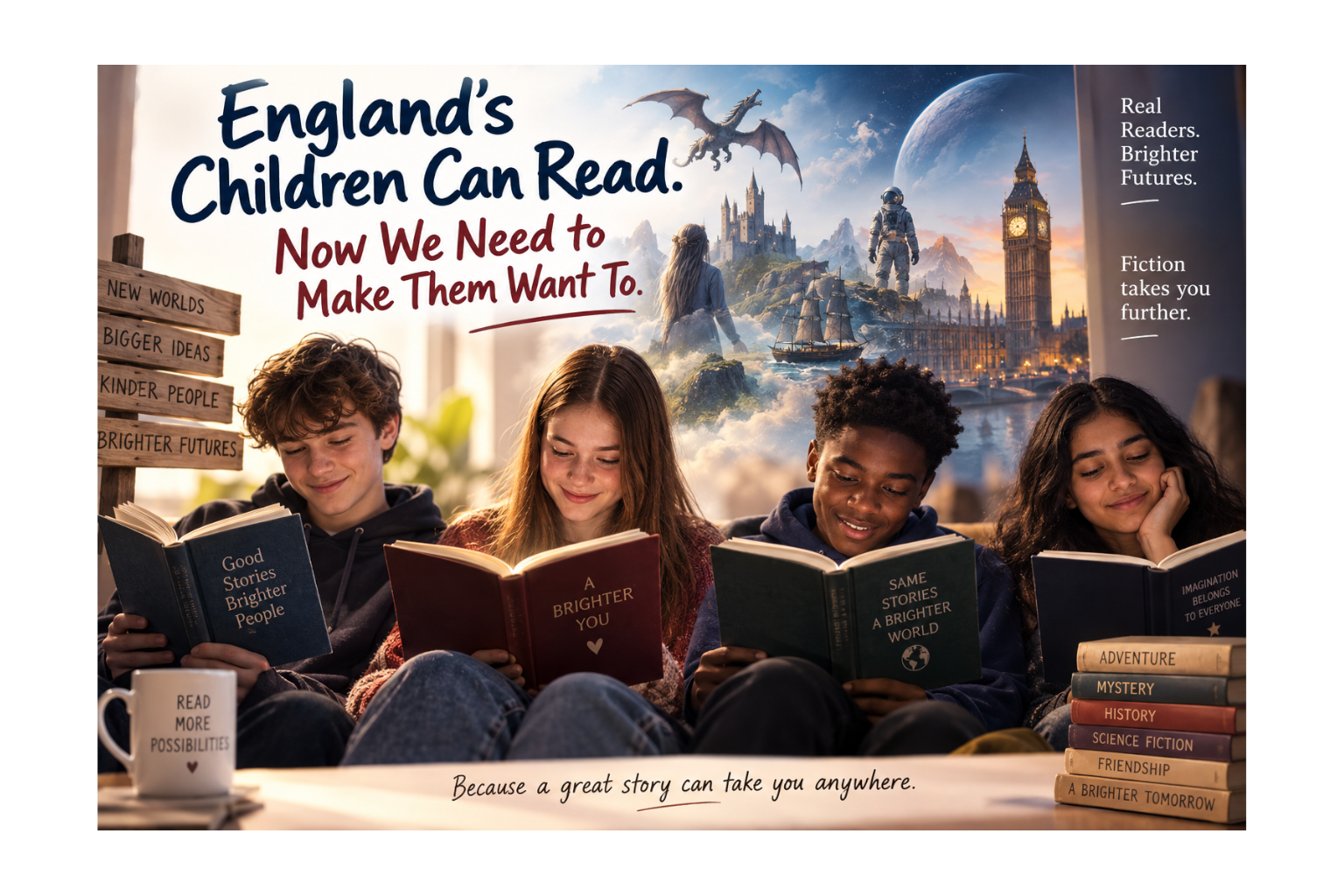
England's Children Can Read. Now We Need to Make Them Want To.
Can a good book be enough to make children read?
There was some rather good news for books today.
England's teenagers are among the best readers in the world.
The latest international education rankings place England's 15-year-olds joint ninth globally for reading. They are also eighth for science and tenth for mathematics.
For once, therefore, we British can look at an international league table without immediately developing an intense interest in cricket.
It is particularly impressive because reading standards have been falling across much of the developed world.
But hidden behind the good news is a rather peculiar contradiction.
Our children are good at reading. They just don't seem particularly keen on doing it.
Research published by the National Literacy Trust earlier this year found that only 36.1% of children and young people aged eight to eighteen said they enjoyed reading in their spare time.
Even fewer, just 20.3%, said they read every day.
Both figures have improved slightly since last year, which is encouraging. But they remain far below the levels recorded a decade or two ago.
So perhaps we have been asking the wrong question.
For years we have worried about whether children can read.
Maybe the next challenge is persuading them that reading is something worth doing when nobody is making them do it.
And that means books have some formidable competition.
A book has no notifications.
It doesn't vibrate.
It doesn't contain a thirty-second video of somebody falling into a swimming pool.
It doesn't urgently inform you that somebody you have never met has uploaded a photograph of their breakfast.
A book just sits there.
Quietly.
Waiting.
And perhaps that is precisely its strength.
Because open one and something rather extraordinary happens.
You can stand on the bridge of the Titanic.
Walk through London during the Blitz.
Travel to Mars.
Solve a murder.
Meet a ghost.
Fall in love.
Fight a dragon.
Or discover that the quiet little girl sitting at the back of the classroom is actually the only person capable of saving the universe.
And you can do all of it without a battery charger.
Reading fiction isn't merely an exercise in literacy. It is one of the first opportunities children have to discover that another human being's imagination can become part of their own.
There is evidence that this matters well beyond examination results. Children themselves report that reading helps them learn, relax, understand themselves and understand other people.
Perhaps, then, the encouraging thing about England's international reading results isn't simply that our children have learned how to read.
We've already given them the key.
The challenge now is persuading them to open the door.
And somewhere, sitting quietly on a bookshelf, in a library, on an e-reader, or perhaps waiting to be discovered free online, there might be one particular story that does exactly that.
Written by Tom Kane.
Copyright © Brittle Media Ltd 2026
Published by Brittle Media Ltd