
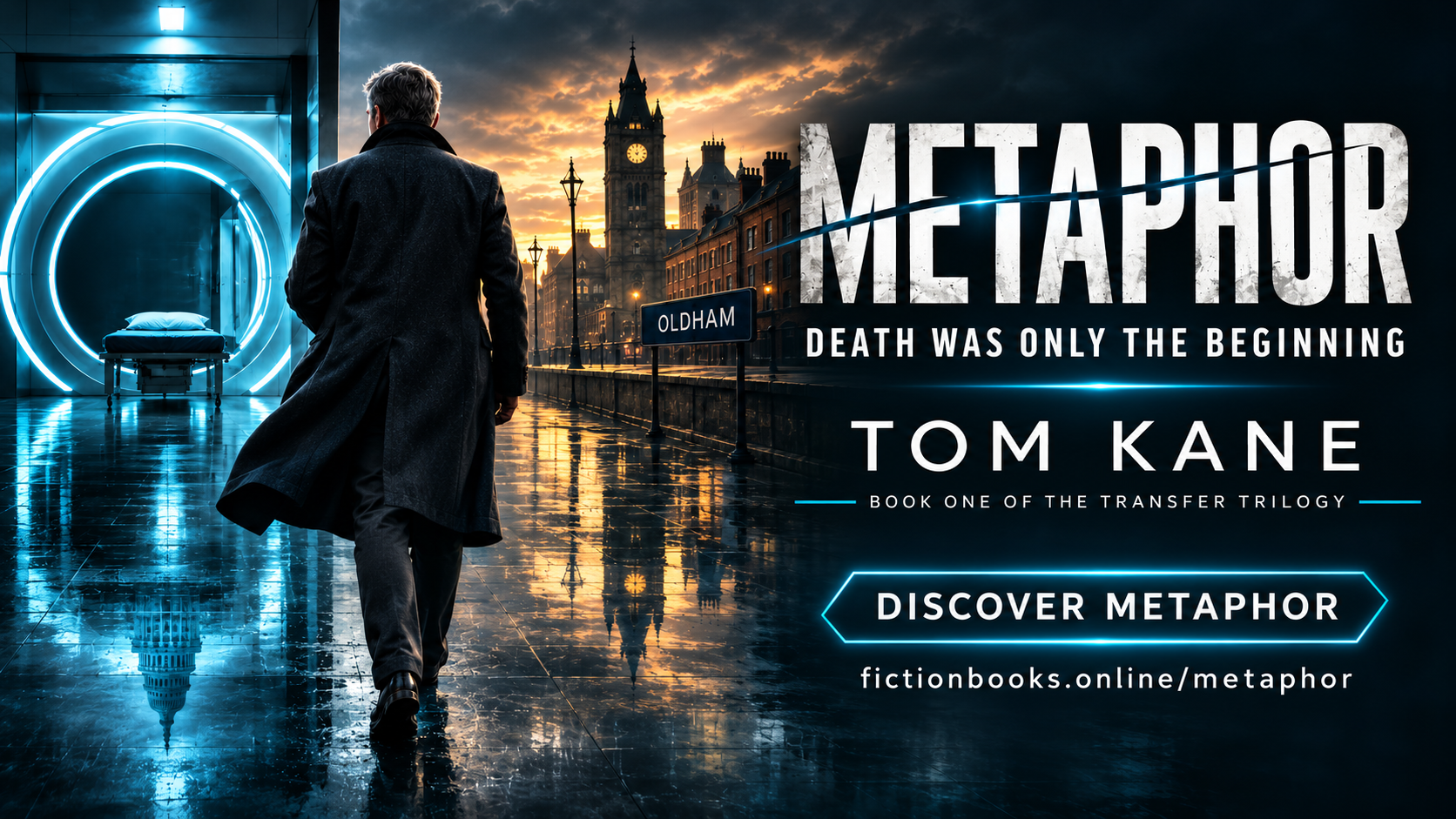
METAPHOR
COPYRIGHT
Copyright © Brittle Media Limited 2026
All rights reserved.
No part of this publication may be reproduced, distributed, or transmitted in any form or by any means, including photocopying, recording, or other electronic or mechanical methods, without the prior written permission of the publisher, except as permitted by applicable copyright law.
For permission requests, contact: https://www.brittlemedia.online
This is a work of fiction. Names, characters, places, and incidents are either the product of the author’s imagination or used fictitiously. Any resemblance to actual persons, living or dead, events, or locales is entirely coincidental.
Author: Tom Kane
Cover: Mack Dundee
Published by: Brittle Media Ltd
ACT I
"Death smiles at us all. All a man can do is smile back." - Maximus
Kendrick
Ben Kendrick first understood that he was dying in a room designed to make death sound manageable.
The walls were a soft medical blue. Not cheerful, not honest. There was a framed print of a lake above the examination couch, a plastic model of a human torso on a shelf, and a clock whose second hand moved with the tiny, officious confidence of machines.
The doctor was called Harriman. He was small, careful and clean, with rimless glasses and hands he kept folded on the desk when they were not rearranging paper. Ben noticed the hands first. Men delivering unwelcome news often tried to hide the body from it.
“I’m afraid the results are conclusive,” Harriman said.
Ben gave him nothing. No flinch. No question. No small human sound that might have made the doctor’s burden easier to carry. He sat in the chair opposite the desk, one ankle resting on the other knee, and watched Harriman pretend the file between them had not become a weapon.
“Aggressive adenocarcinoma,” Harriman said. “Metastatic. The primary site is less important now than the spread. Liver involvement, pulmonary nodules, lymphatic activity. There are signs of neurological risk, though not yet impairment.”
He said impairment as if offering Ben a small courtesy.
Ben looked past him to the window. Arlington in a warm September glow lay beyond the glass, though leaves on some trees were already turning. The official buildings, traffic moving under a deep blue sky. The world outside had the insolent continuity of places not yet informed they were ending.
“Timeline,” Ben said.
Harriman blinked. He had expected why. Perhaps how. The small theatrical disbelief civilians offered doctors because they wanted to negotiate with medicine. Ben had no interest in negotiation. Negotiation required a counterparty with authority.
“Without intervention, months,” Harriman said. “Possibly fewer. With treatment, there may be a response. Chemotherapy, targeted protocols if the molecular panel supports them, palliative radiotherapy if pain develops. We would need to move quickly.”
“Median extension?”
“Difficult to say.”
“Say it anyway.”
Harriman looked down at the file, though both men knew the number was already in his mouth. “Six to nine months, if treatment is tolerated. Perhaps more. Perhaps less.”
There it was. Hope, reduced to a range and wrapped so carefully it could almost pass for kindness.
Ben asked about pain, cognition, loss of function, dependency, nausea, infection risk and whether the treatment would affect memory. Harriman answered each question with the relief of a man allowed to return to doctrine. Ben listened. He had survived interrogations with less discipline than modern oncology.
When Harriman finished, he placed one hand on the folder as though preventing the disease from leaving it.
“You don’t have to decide anything today,” he said.
Ben stood before the doctor could soften the room any further. “I already have.”
Harriman rose too quickly. “Mr Kendrick, I would strongly advise against making an immediate decision. There are treatment pathways. Trials. Second opinions. Pain can be managed. Quality of life can be preserved.”
Quality of life. Ben had always admired phrases that sounded humane while concealing surrender.
“I’ve seen preserved things,” Ben said. “They belong in jars.”
Harriman’s face tightened. He had mistaken bluntness for courage. People often confused ugliness with strength when it spared them tenderness.
“At least allow me to refer you to a specialist team,” Harriman said. “You should have all the information before refusing care.”
Ben shook his head and picked up the envelope of reports, thanked the doctor because manners remained useful even when hope did not, and left by the stairs.
Outside, the air had the taste of coming rain. Ben stood on the pavement with the envelope under one arm and watched people pass him in both directions, all of them still employed by the future. A courier with a headset. A woman laughing into a phone. A man carrying coffee in a cardboard tray with the rare care of someone transporting medicine. They moved around Ben without noticing that a verdict had just been handed down inside the building behind him.
He considered calling a taxi, then walked instead. It was not discipline exactly. It was resistance to becoming a passenger in his own decline. The apartment was twenty-three minutes away on foot if he cut through the narrow streets behind the medical complex and avoided the larger roads. He knew the route because he knew all routes within a mile of any room where people possessed records about him.
By the time he reached home, the first drops had begun to fall. His building stood in a row of expensive discretion: brick, glass, anonymous lobby, cameras in the ceiling corners and a concierge who had learned never to remember too much. Ben nodded to him, took the lift alone, and watched his own reflection in the polished doors ascend with him.
The apartment was quiet when he opened it. Quiet, but not empty. Emptiness had honesty. This place contained the accumulated evidence of a man who had spent years pretending not to settle. A narrow kitchen. A leather chair angled towards the window. Books stacked beside it in small acts of optimism. A coat by the door. Two glasses in the cabinet. One bed made with military neatness and civilian loneliness.
Ben placed the medical envelope on the table and did not open it. He had already heard enough of what was inside. Paper had a way of pretending repetition was proof.
He made coffee out of habit. While it brewed, he took a yellow legal pad from the drawer and wrote a heading at the top in block capitals: CLOSURE. Then, beneath it, a list.
He did not search for miracles. Miracles were what frightened people hoped for when evidence had become finality. He searched instead for countries with procedures, laws with edges, clinics that understood consent as something more dignified than endurance. Switzerland appeared three times in the first hour, always in the clean language of eligibility, witnesses, medical records and waiting periods. Ben read every page. Then he read the pages behind the pages: cost, jurisdiction, documentation, disposal, the careful civic grammar by which a living man became an authorised absence.
The clinic he chose was outside Zurich, modest in its claims and exacting in its demands. That reassured him. Anything too soothing would have been selling death as tourism. Anything too reluctant would have been selling guilt as morality. This place asked for scans, statements, psychiatric confirmation, proof that he understood the finality of the act and proof that no one had persuaded him towards it. Ben almost admired the thoroughness. After a life spent inside institutions that killed by euphemism, here at least was one that required a man to sign for the truth.
He printed the preliminary form, filled it out by hand, and paused only once, at the line asking for his reason. Pain would have been acceptable. Prognosis would have been tidy. Loss of dignity would have sounded familiar enough to pass. He wrote none of them. In the narrow box provided, Ben Kendrick wrote: While I am still competent to choose.
Bank accounts. Pension. Lease. Utilities. Storage unit. Agency medical. Secure deposits. Personal effects. Digital records. Letters. Disposal.
He looked at the list and felt, not sadness exactly, but the small humiliation of seeing a life reduced to administration. A country needed treaties to dissolve itself. He needed passwords, signatures and postage.
The coffee finished. He poured it black, drank half standing at the counter, then opened the laptop he had intended to replace and began removing himself from the world.
First came money. Not because it mattered to the dead, but because it mattered terribly to the living who processed them. He moved what could be moved. Closed one account. Left another open for final payments. Redirected a sum to a veterans’ charity under a name that would mean nothing to the donors and less to the recipients. He arranged for the remainder to pass through a trust administered by a lawyer in Delaware who had once smuggled asset payments through three jurisdictions and now specialised in estate planning for men with complicated consciences.
The lawyer answered on the second ring.
“Ben,” Michael Ayles said. “You sound ominous.”
“Professional hazard.”
“How final are we being?”
“Completely.”
There was a pause long enough for affection and short enough to preserve dignity.
“Medical?” Ayles asked.
“Yes.”
“Treatment?”
“No.”
Ayles breathed out through his nose. Ben heard the office around him: filtered air, distant copier, the soft hum of expensive carpet absorbing consequences.
“All right,” Ayles said. “Tell me what needs to happen.”
Ben told him. The lease was to be terminated after confirmation of death, not before. The furniture could go to auction except the chair, which was to be donated without explanation to the reading room at the veterans’ hospital in Bethesda. The books could be boxed and sold. The secure deposit in Alexandria was to be emptied by Ayles personally and burned according to the instructions already sealed in his office.
“You still have that envelope?” Ayles asked.
“You still bill by the hour?”
Ayles gave a dry laugh and then, mercifully, stopped trying to be kind. Kindness had weight. Ben had enough to carry.
When the call ended, the apartment seemed to settle around him, as if listening for the next instruction. Ben wrote Ayles’s initials beside three items on the pad, drew a line through money, and turned to the objects that could not be handled by lawyers.
The passports lived in a fireproof box at the back of the hall cupboard, beneath a rolled extension cable, two spare smoke alarms and a pair of walking boots he had bought in a moment of delusion about retirement. The box was heavy, black and ugly, the kind of thing sold to civilians with the promise that a life could be protected by hidden hinges.
Inside were five passports, two American, one Canadian, one Irish and one British, each built around a name that had once walked, eaten, lied and crossed borders with Ben’s face. Martin Hale. Peter Sloan. Daniel Fiske. Thomas Reeve. Harold Mercer. Governments loved names because names made men taxable, trackable and, in moments of necessity, disposable.
He spread them out in a line. Five little graves with gold stamps.
Martin Hale had entered Belgrade in winter and left with a diplomat’s blood under one thumbnail. Peter Sloan had spent six weeks in Cairo pretending to sell security software to men who already owned every lock. Daniel Fiske had been married on paper to a woman in Montréal he had never met, a bureaucratic romance designed to move money through a door that did not otherwise exist. Thomas Reeve had died twice in training exercises and once in a hotel in Baku, where a clerk had forged his signature beautifully. And good old Harold Mercer? He had hardly had time to get his passport before he was relegated to the back of the drawer. Unwanted and surplus to requirements.
Ben took a pair of scissors from the drawer and cut through each photograph first. Faces went before names. That seemed proper. Then he cut the biometric pages into strips, the visas into smaller pieces, the stamps into confetti. Years of movement came apart under his hands: airports, safe houses, checkpoints, hotel desks, border guards with bored eyes and the private little thrill of being waved through under a life not his own.
He fed the pieces into the sink, soaked them with washing-up liquid, and ground them into pulp with the back of a spoon. Fire was theatrical. Pulp was final. A flame left ash. Water left nothing useful.
When he finished, he rinsed the sink clean and stood for a moment with both hands braced on the counter. Five men had disappeared without complaint. They had never existed, which made their deaths efficient. Ben wondered, not for the first time, whether he had been practising.
The books were harder.
Not because they were valuable. They were not. Most were paperbacks with cracked spines, histories of failed empires, biographies of men who confused conviction with destiny, a few novels bought in airports and never opened. They sat beside the chair in uneven stacks, each one a small promise he had made to a quieter future.
He had imagined retirement as a room with weather outside and no one asking for his opinion on death. He would read in the mornings. Walk when his knees allowed. Cook badly. Perhaps learn the names of birds, an ambition so modest it embarrassed him. Instead, the books had accumulated beside the chair like unpaid debts.
Ben lifted the top one from the stack. A history of Carthage. Page marker at chapter two. He had stopped reading it seven months earlier because a sentence about siege engines had reminded him of a man in Mosul who once built bombs out of irrigation pipe and religious certainty. Memory had spoiled worse things than books.
He made three piles on the floor. Sell. Donate. Destroy. The first two grew slowly. The third grew faster than it should have. Marginalia was evidence. Names written on flyleaves were evidence. Receipts used as bookmarks were evidence. A dead man ought to leave fewer breadcrumbs than a careless tourist.
One book resisted him. A small hardback of poems, dark blue cloth, no jacket. It had belonged to Claire. Not wife, not exactly. Not lover by the end. Not anything ordinary enough for language to handle without lying. She had given it to him in Lisbon after an operation neither of them had been authorised to survive.
On the inside cover she had written only his name. Ben. No surname. No joke. No flourish. At the time, he had thought the restraint elegant. Now it looked like mercy.
He stood with the book in his hand while rain tapped at the window and the coffee went cold in the mug. He could keep it. No one would know. One small object, private enough to forgive. A scrap of proof that someone had once said his name without needing cover from it.
Ben opened the book to the inscription, touched the paper once with the pad of his thumb, then placed it in the donate pile face down, as if even tenderness required plausible deniability.
Sentiment was not evidence, but it behaved similarly under pressure.
Dusk arrived without permission. The apartment darkened by degrees, the windows turning black and reflective until Ben could see himself moving through the rooms like an intruder. He boxed the books, labelled them for collection, and carried the destroy pile to the shredder in the study.
The shredder overheated after the third book. Ben waited beside it while the motor cooled, listening to the small, defeated, clicks of a machine unequal to the destruction of literature. When it resumed, he fed the pages in handfuls. History became strips. Poetry became strips. His own pencilled notes became strips. The bag filled with pale, unreadable ribbons.
Last was the coat.
It hung by the door where it had hung since November, dark wool, good lining, repaired once at the cuff by a Turkish tailor in Queens who had recognised quality and said nothing about the dried blood on the sleeve. Ben had intended to wear it through another winter. Then another. The coat was the sort of practical object that smuggled hope by pretending to be clothing.
He took it from the hook and felt its weight settle across his forearm. The pockets held the minor archaeology of ordinary life: a dry-cleaning ticket, two quarters, a tram receipt from Vienna, a paperclip bent into a useless shape, and a pair of gloves he had forgotten buying. Nothing classified. Nothing dangerous. Nothing that explained why the object felt like an accusation.
Winter was coming without him. That was the fact his mind had avoided, not out of fear but out of distaste. He had prepared for endings in hostile rooms, on bad roads, in aircraft waiting on the tarmac. He had not prepared for the small insult of a coat outliving him.
For a moment, he considered leaving it hanging. Let Ayles deal with it. Let some removal man push it into a carton with the umbrella, the spare light bulbs and the shoes Ben no longer needed. But the thought irritated him. Delegating a farewell did not make it cleaner. It only made someone else touch the wound.
He folded the coat carefully. Not perfectly, carefully. There was a difference. Perfect belonged to institutions, uniforms, inspection. Careful belonged to the hand. He laid it across the leather chair, smoothed the shoulders, and placed the gloves on top.
The room changed when he did that. Not visibly. The kitchen remained narrow, the books boxed, the rain steady, the cheap lamp burning at the edge of the desk. But the apartment had stopped being a place he occupied and become one he had already left. Ben stood in the doorway and understood that departure sometimes happened before movement.
He looked once more at the legal pad. CLOSURE. The word seemed too neat now. Closure belonged to people who needed endings to behave. What Ben had made was a controlled demolition.
Melanie Chisolm
Melanie Chisolm saw Ben Kendrick for the first time through rain and glass.
He was standing outside the Zurich hotel without an umbrella, one hand resting lightly on the handle of a black suitcase, the other tucked into the pocket of a charcoal overcoat. He looked neither lost nor ill. That was the first cruelty. The file said metastatic disease, terminal progression, limited window, declining function. The man on the pavement looked like someone waiting for harsh weather to stop.
She watched from the café opposite, behind a table too small for the equipment hidden beneath her coat. The espresso in front of her had gone cold. She had ordered it because people alone in cafés needed props, and because the Swiss, even in conspiracies, expected a certain respect for commerce.
On her phone, a secure message waited without asking to be opened.
Subject confirmed. Proceed only if clinic chain remains intact.
Clinic chain.
The phrase had been designed by people who mistook ugliness for professionalism. It meant the amended vial had reached the building, the medical certification had passed, the local staff had no idea they were participating in anything except lawful death, and Ben Kendrick would be sedated, instead of killed.
It also meant that no one had asked him.
Melanie had not found a way around that fact. She had walked around it, built scaffolding over it, covered it with necessity and urgency and the kind of moral arithmetic intelligence services taught people before letting them near budgets. But the fact remained beneath everything.
Ben Kendrick had chosen to die.
She was about to steal the ending he had chosen because leaving him to it would allow Carter to bury a larger crime beneath a smaller one.
Carter would call it preservation of strategic capability, an emergency intervention. Melanie, in the privacy of her own head, called it what it was and hated herself for the accuracy.
Three years earlier, she would have written an objection and expected the objection to matter. She had still believed that institutions kept forms because forms could stop people. Since then, she had learned that paper more often served as insulation. A signature did not prevent harm. It merely told the harm where to send its invoice.
Melanie had entered intelligence by accident, if accidents could involve two doctorates, a security interview conducted in a windowless room and a research grant whose harmless title concealed a military appetite. She had been a specialist in neural continuity: the stubborn ways memory, identity and biological pattern survived trauma. The work had begun with stroke patients and damaged tissue. It had ended with men like Carter asking whether a person could be separated from the place in which death expected to find them.
She had said no at first. Not dramatically. No slammed door, no brave denunciation. She had said that the models were incomplete, that continuity was not consciousness, that a copied pattern might be resemblance wearing a pulse. Carter had asked what budget would make the models complete.
The first successful animal transfer had not looked successful. A sedated dog had vanished from one sealed enclosure and appeared in another beneath a clean white light. Its heart had continued. Its blood chemistry had settled. It had responded to its name. Everyone in the room had begun to applaud until Melanie noticed that it would not cross the painted line on the floor.
For nine minutes, the animal stood with one paw raised over a boundary that had existed only in the source room. Then it began to whine at an empty corner. Carter had called the behaviour post-procedural disorientation. Melanie had called it evidence. The report used Carter’s phrase.
That night, she had watched the recording alone. Frame by frame, the dog appeared whole. Frame by frame, one camera showed a shadow arriving half a fraction before the body that made it. The discrepancy was beneath the programme’s tolerance. It sat well within the margin they had agreed to call noise.
Melanie had kept a copy.
It was still hidden in a storage unit outside Bern, sealed inside the casing of a broken microscope beside notebooks no security team knew existed. The notebooks contained dates, tolerances, failed returns and names removed from official logs. They contained twelve pages on a legacy channel labelled HARROW.E and one sentence Melanie had written after waking from a dream in which someone kept knocking from inside a locked room: A system that preserves pattern may also preserve refusal.
She had shown the sentence to no one. Carter would have understood it and requisitioned them.
Across the street, Ben shifted his weight and looked towards the hotel entrance. Nothing in the movement suggested uncertainty. He had the stillness of someone who had spent years letting danger reveal itself first. Melanie knew his service history in the improper, fragmented way classified programmes knew people: redacted operations, medical tolerances, psychological flags, fragments of testimony, recommendations signed by men who later denied remembering him.
She knew he had refused extraction twice when civilians remained behind. She knew he had once crossed a border under a dead diplomat’s name and returned with a bullet lodged close enough to the spine that three surgeons had argued over who possessed the courage to remove it. She knew he slept badly, distrusted kindness and had destroyed five passports in Arlington two days after receiving the diagnosis Carter had manufactured.
That last detail had come from a surveillance note.
Subject engaged in identity disposal. No distress response observed.
The analyst had meant to describe behaviour. Instead, without intending to, they had documented grief.
Melanie had read the note at two in the morning in a secure office outside London. She had imagined the passports laid out on a kitchen counter, each false name waiting to be cut from his face. Until then, Kendrick had been a candidate profile. Afterwards, he became a man tidying his own absence.
Her phone vibrated once against the table. Not the secure message this time. A local number, unrecognised. Melanie let it stop. A moment later, a text appeared.
Your mother has been moved to Thursday. Please confirm.
For several seconds, she did not understand the words. Then ordinary life returned with its indecent timing. Her mother’s neurology appointment. The one Melanie had promised to attend. The one concerned with small lapses, lost keys, repeated questions and a woman who had once remembered every pupil she taught beginning to distrust her own kitchen.
Melanie typed, I will be there. She looked at the sentence, deleted it and wrote, Confirmed.
The lie was tiny compared with the one waiting across the street. That did not make it lighter.
Theft
She had taken the 07:06 from Bern under a name that belonged to an American pharmaceutical consultant who existed only in invoices. The train had been almost empty at first, then gradually populated by commuters, students and a priest who spent twenty minutes trying to sleep without appearing to. Melanie sat with her back to the carriage wall and the equipment case between her feet, one hand resting on the handle as if anyone looking closely might believe she was attached to it by habit rather than fear.
The case looked too small for the crime it carried. That was one of the things Melanie had learned from working around classified programmes: history usually arrived in ordinary packaging. She was not a field officer. She belonged to laboratories, authorisations and liaison rooms, which made the badge, the vials and the service door feel less like a mission than an act of trespass.
Carter called as the train passed through Olten. He did not say good morning. Carter believed courtesies were weaknesses people hid inside grammar.
“Status,” he said.
Melanie watched grey fields slide past the window. “En route. Subject arrived in Zurich last night. Clinic intake confirmed. Supplier access remains clean.”
“Do not call him subject.”
That surprised her. Not the correction; the ownership inside it. Carter could reduce a village to variables if the map required it, but Ben Kendrick had earned a category of attention beyond the ordinary ugliness of their work.
“His preferred name is Kendrick,” Carter said. “His useful name is Ben. Remember the difference.”
Melanie shifted the case with her foot. “I thought we were preserving him, not claiming him.”
“Those are not mutually exclusive ambitions.”
She watched her reflection tremble faintly in the train window. “He has not consented.”
“He consented to die,” Carter said. “We are improving that outcome.”
“That is not ethics. Consider it correcting grammar with a knife.”
For the first time, Carter sounded amused. “This is why scientists should not be given moral vocabulary. It slows them down.”
“And this is why soldiers should not be given miracles.”
Silence followed. She had gone too far. Carter allowed people rope, not because he enjoyed mercy, but because he liked seeing whether they would hang themselves.
“Proceed,” he said. “If the chain breaks, leave him. If the clinic alarms, leave him. If Sir Adrian Vale interferes, call the second number. If Kendrick wakes before the window opens, do not improvise.”
“And if he asks me who I am?”
“Then he’s not sedated enough.”
The call ended before she could answer.
Vale called six minutes later.
“Tell me you are still on the train,” he said.
“I am still on the train.”
“That was reassurance, not instruction.”
Vale sounded older than he had the previous night, which frightened her more than Carter’s threats. Carter made danger sound inevitable. Vale made regret sound educated.
“Carter moved the receiving team,” Vale said. “I’ve lost sight of two names on the manifest.”
Melanie closed her eyes. “Then cancel.”
“We cannot cancel. If we cancel, Carter lets the clinic proceed and Ben Kendrick dies on schedule. If we proceed, we may at least put him somewhere Carter does not control.”
May at least.
Intelligence work is built from phrases like that. May at least. Acceptable risk. Contingent value. Emergency authority. Each one a cloth laid over a table where something human had been cut open.
“He thinks he’s dying,” she said.
“Yes,” Vale said. “And someone made him believe it. Not with a forged letter or a bribed receptionist. With records, scans, specialist confirmations and access to the medical channels he trusted least because he understood them best. That is why we need him alive.”
“That’s also why he’ll hate us.”
“Probably,” Vale said. “If he lives long enough.”
By the time Melanie reached the clinic, the rain had thickened over Zurich and made every reflective surface complicit. The building stood above the city with its white walls, polished brass and clean windows, offering the civic lie that mercy could be made orderly if one hired the right architect.
She entered through the service door at twelve minutes past noon, wearing the badge of a medical-supply auditor and the expression of someone too busy to be challenged. Busy was one of the great disguises. It made guards, nurses and reception staff feel that obstruction would be ruder than negligence.
The cloned badge opened the first door. The second required a code she had been given. Melanie entered it from memory and hated herself for remembering so well.
The pharmacy room was small, pale and private. A temperature-controlled cabinet hummed against one wall. On the counter lay the day’s prepared trays, each labelled with a patient number, a procedure time and the careful anonymity of medicine. Ben Kendrick’s tray sat third from the left.
She verified the label twice. Kendrick, Benjamin. 16:00. Final compound. Witness confirmation pending. The words were ordinary enough to be obscene. A man had signed them into legitimacy. She was about to make them false.
Her hands did not shake until the sterile sleeve came out of the case. That annoyed her. Fear she could forgive. Incompetence she could not. She breathed once, counted the instruments, broke the first seal and lifted the clinic vial from its cradle.
The liquid inside was clear. So was hers. That seemed both unfair and exactly the point. Evil rarely announced itself with colour. It preferred transparency, signatures and refrigeration.
She transferred the substitute compound into the clinic vial with the slow precision of a woman defusing her own conscience. Sedative blend, respiratory mimic, stabiliser, neural suppression buffer. Enough to convince observers that death had begun. Enough, in theory, to preserve him for the window.
In theory. Those two words belonged on every grave intelligence had ever dug for science.
A trolley rattled somewhere beyond the door. Melanie froze with the vial in one hand and the seal in the other. Footsteps paused outside. Two voices murmured in German. One laughed softly. Then the footsteps moved away. The room released her half a breath at a time.
She resealed the vial, replaced it on Ben’s tray, and put the original compound into the equipment case. It weighed almost nothing. It should have weighed more. Murder displaced ought to have mass.
At 14:07, from the end of the corridor, she saw him in person again.
Ben Kendrick walked beside Anna Weiss with his suitcase in one hand and no visible fear. That was almost worse than fear would have been. Fear might have given Melanie something to rescue. Calm made her crime exact.
He paused beside the window where rain drew thin vertical lines down the glass. For a second, he turned his head and looked along the corridor. Melanie stood partly behind a linen cart, badge visible, face neutral, pulse violent. His eyes passed over her once and did not stop. She had never been more grateful to be unimportant.
At 15:31, Carter sent one word.
Window.
Melanie went to the maintenance alcove where her receiver case had been hidden behind stacked paper towels. The screen inside showed a set of coordinates outside Manchester, green status bars and a countdown that had no right to look so calm.
16:06 Zurich time; 15:06 in Britain. Six minutes after ingestion, the window would open for eleven seconds. The time difference made the operation look orderly on paper, but the same minute would become evidence in two countries: a man dying in Zurich and a receiving corridor in Manchester waiting for him before death could finish its paperwork.
At 15:58, she stood outside the procedure room with one gloved hand on the equipment case and heard the doctor ask whether Ben was ready.
There was a pause. Then Ben said, “Yes.”
One clean word. No bargaining. No appeal. Melanie found herself hating him for making the theft look worse.
Glass touched wood inside the room. The doctor murmured something. A chair shifted. Then silence settled with institutional gentleness.
Melanie entered when the attendant stepped out for warm water. She had thirty seconds, less. Ben lay on the couch beneath a blanket, eyes half-open, face already loosening under the drug. The folded note sat on the side table beside his watch.
She read only the first words because reading all of it would have been another theft.
I made the choice...
His fingers moved once against the blanket. Not reaching. Not resisting. Merely proof that he still belonged to himself for another few seconds.
The receiver in her pocket vibrated twice. Window alignment. Imminent.
Melanie stepped closer. Close enough to see the scar under his jaw, the grey at his temples, the exhaustion that the false diagnosis had taught him to call acceptance. She wanted to say that she was saving him. She wanted to say that if he knew what Carter had done, he would forgive the trespass. She wanted the future to justify the present in advance.
None of those sentences was true enough.
So, she gave him the only thing small enough not to become a lie.
“I’m sorry, Ben,” she whispered.
His eyelids trembled, as though some last surviving part of him had recognised the wrongness in the room. Then the monitor in her pocket gave one soft pulse.
For one irrational second, the receiver in her pocket gave not a pulse but a pressure, as if someone on the other side of the signal had placed a hand over hers and held it there.
Melanie did not leave Zurich. Her body stayed in the clinic’s maintenance alcove, half-hidden behind stacked paper towels and a locked service cabinet, one gloved hand clamped around the receiver case while the procedure room breathed its soft lies beyond the wall. The device took her before the signal did. White towels, disinfectant and the muffled mercy of the clinic remained around her, but another room opened inside the first: Manchester, cold concrete, observation glass, Carter’s men already in place. Metaphor had never moved only bodies. In emergencies it could borrow an operator through the alignment, leaving the source hand on the case in Zurich and the receiving hand flat against a console hundreds of miles away. Vale had called it remote attendance. Carter called it command continuity. Melanie had called it impossible until it happened to her.
The window opened.
Receiving Corridor
Manchester, 15:05 British local time. Five minutes after Ben Kendrick drank in Zurich, Melanie Chisolm was present in the receiving corridor beneath the old exchange, not by aircraft, road or miracle, but by the same borrowed technological alignment she had forced open for him. In Zurich, in reality, she stood in the clinic’s maintenance alcove with one hand on the receiver case. In Manchester, Metaphor gave her a holographic second position behind the observation glass. Metaphor used her pre-scanned data and created a three-dimensional holographic image with all the tactile abilities of the real Melanie Chisolm in Zurich. Two countries and one stolen consent away from the room where she had whispered Ben’s name.
In Manchester, the receiving corridor waited for Ben Kendrick with its lights reduced to surgical white and its doors sealed at both ends.
Melanie Chisolm’s hologram stood behind the observation glass with one hand pressed flat against the console, as if holographic skin could steady mathematics. Below her, the corridor stretched between two magnetic locks, empty except for the receiving mark painted on the floor and the four-armed men Carter had placed where orderlies should have been.
“Too many people,” Melanie’s hologram said.
Carter did not look up from the wall display. “It’s the correct number of people.”
The display showed Zurich, Manchester, Zurich again: three panels of figures, coordinates and live medical telemetry. Ben’s pulse moved across the centre screen in a thin green line. Consciousness suppression held. Respiratory mimic held. Identity lock held. Every status bar was green, which Melanie had learned to distrust more than red. Red admitted danger. Green expected obedience.
On the floor below, one of Carter’s men shifted his weight and checked his weapon. Melanie watched the gesture and felt the first clean line of fear open beneath her ribs.
“He is sedated,” she said. “He’ll be confused, hypoxic and chemically suppressed. He’s not a prisoner.”
“He’s an asset whose legal death will be confirmed in another jurisdiction within the hour,” Carter said. “Those conditions require custody. Once the world accepts that Ben Kendrick is dead, any living version of him becomes government property unless he reaches someone inconvenient first.”
Melanie looked at the clock. 15:05:41.
Nineteen seconds.
The receiver plates beneath the corridor floor began to hum. It was not loud. That made it worse. There should have been drama in a machine capable of humiliating geography. Instead, there was a low vibration through glass, concrete and bone, the sound of a locked room preparing to deny distance.
“Window opening,” the technician said.
Melanie watched the empty receiving mark. In Zurich, Ben Kendrick had drunk from a glass minutes earlier. In Manchester, four men waited to put hands on what remained of him. Between those two facts, for eleven seconds, the world was supposed to become simple.
It did not.
The lights in the corridor dimmed once, not out but down, as if something larger than the building had passed between it and its power. The green line on the medical display flattened, vanished, returned as three separate pulses, then became a block of unreadable white. Every alarm in the room remained silent. That was the first wrong thing.
On Melanie’s lower screen, an auxiliary status flickered once and vanished before the technician noticed it: HROW/LEGACY CHANNEL ACTIVE.
The second was the shape in the corridor.
For eleven seconds, Ben appeared above the receiving mark, but not as a man appeared. He was there as a cascade of shadows, shoulder, hand, face turned slightly away, the outline of a body refusing to finish. One of Carter’s men stepped forward. The image of Ben walked towards him, tried to speak, thinned and folded into nothing.
Melanie saw one detail clearly enough to distrust it afterwards. Ben’s left hand was not falling. It was pressed flat against something invisible, palm out, as though another hand met it from the wrong side of glass.
Then the corridor was empty again.
No arrival tone sounded. No failure alarm sounded. The system did not know which confession it owed them.
“Where is he?” Carter asked.
Nobody answered. The question went unanswered by a room full of experts.
Melanie pushed past the technician and took the console. “Run the recovery sweep.”
“It’s already running.”
“Then run it again… properly.”
The wall display refreshed.
TARGET STATUS: UNRESOLVED.
SOURCE EVENT: CLOSED.
RECEIVER EVENT: PARTIAL.
BIOLOGICAL MASS: NOT PRESENT.
IDENTITY PATTERN: PRESENT.
Melanie read the five lines twice and understood none of them in a way that helped.
Carter moved beside her. “Can he survive that?”
“That? Who knows,” Melanie said.
Below them, the armed men searched an empty corridor with the helpless anger of men trained for bodies. One checked the marked floor as if Ben might have fallen through a crack. Another lowered his weapon and looked towards the observation glass. Melanie saw the question in his face and looked away before he could give it to her.
The printer behind her started.
One sheet. Then another. Then nothing.
The technician picked up the first page, frowned, and put it down again too quickly.
Melanie took it from him. Across the top, where the routing summary should have been, the printer had produced one line of text in capital letters.
HOLD.
The second page was blank except for a timestamp that did not belong to the operation.
Below the number, too faint to read, was a second line the printer had failed to darken properly: DO NOT RELEASE TO CARTER.
04:19.
She felt Carter look toward the paper before she looked up.
“What is that?” he said.
“Nothing. Just stats,” Melanie said.
This is Harrow. Time for plan B. Time to leave.
She folded the paper, ripped it into pieces and committed it to the trash can.
Melanie Chisolm disconnected her hologram and vanished.
There were numbers every scientist learned to distrust because they had appeared once in a file and then again in a nightmare. Four hours and nineteen minutes was buried in the oldest incident archive, attached to a failed transfer, an erased military observer and a name no one in Carter’s laboratory liked to say aloud.
Carter’s focus was on the main screen and what had happened to the transfer. He never noticed Melanie’s disappearance.
“Lock the building,” he shouted. “Kill external feeds. No one leaves this floor.” By the time he spoke the last words, Melanie was already setting in motion her transfer from Zurich to England but not knowing where her quarry was.
The recovery sweep continued. Minutes passed. Eleven. Twenty. Forty-three. The wall display tried to turn absence into coherence and failed in a new way each time.
TARGET STATUS: UNRESOLVED.
TARGET STATUS: CROSS-LOCKED.
TARGET STATUS: HOLDING.
TARGET STATUS: NOT LOST.
That last line stayed on the screen for eight seconds before deleting itself.
A buried subroutine opened and closed on the diagnostic panel so quickly it looked like glare.
HARROW.E / HOLDING PATTERN / ACCEPTED.
“Where is he?” Carter shouted.
***
Four hours and nineteen minutes after the window opened, the console gave a single recovery tone.
Not the clean arrival tone. Not the failure tone. A third sound, old enough that none of the younger technicians recognised it. It belonged to the archived equipment, to test rooms with paper logs, to the era before Carter had given Metaphor polished screens and deniable contractors.
A location appeared on the wall display.
OLDHAM. PENNINE ROYAL HOTEL. ROOM 214.
Nobody spoke. The corridor below remained empty, bright and sealed, waiting for a man who had arrived somewhere else.
Carter stared at the wall display. “What the hell is this?”
Map coordinates appeared and disappeared. The display flickered and the screen died.
“Recovery,” Carter shouted. “And where’s Chisolm?”
Many miles away, in Zurich, Melanie Chisolm had a head start. She stood on the mobile platform, installed deep in the bowels of the Swiss clinic, and readied herself.
A click on a remote handset and Metaphor transferred her from Zurich to a reference point in England, close to where she expected Ben Kendrick to appear.
When Metaphor works, it works well.
Melanie was thankful for that. Otherwise, she too would be a ghost in the machine.
Melanie began her search for Ben Kendrick using old Metaphor nodes in northern England to fulfil her plan.
To find Ben Kendrick.
End of Free Chapters
To read more from this book, please click here to see the purchase options.