
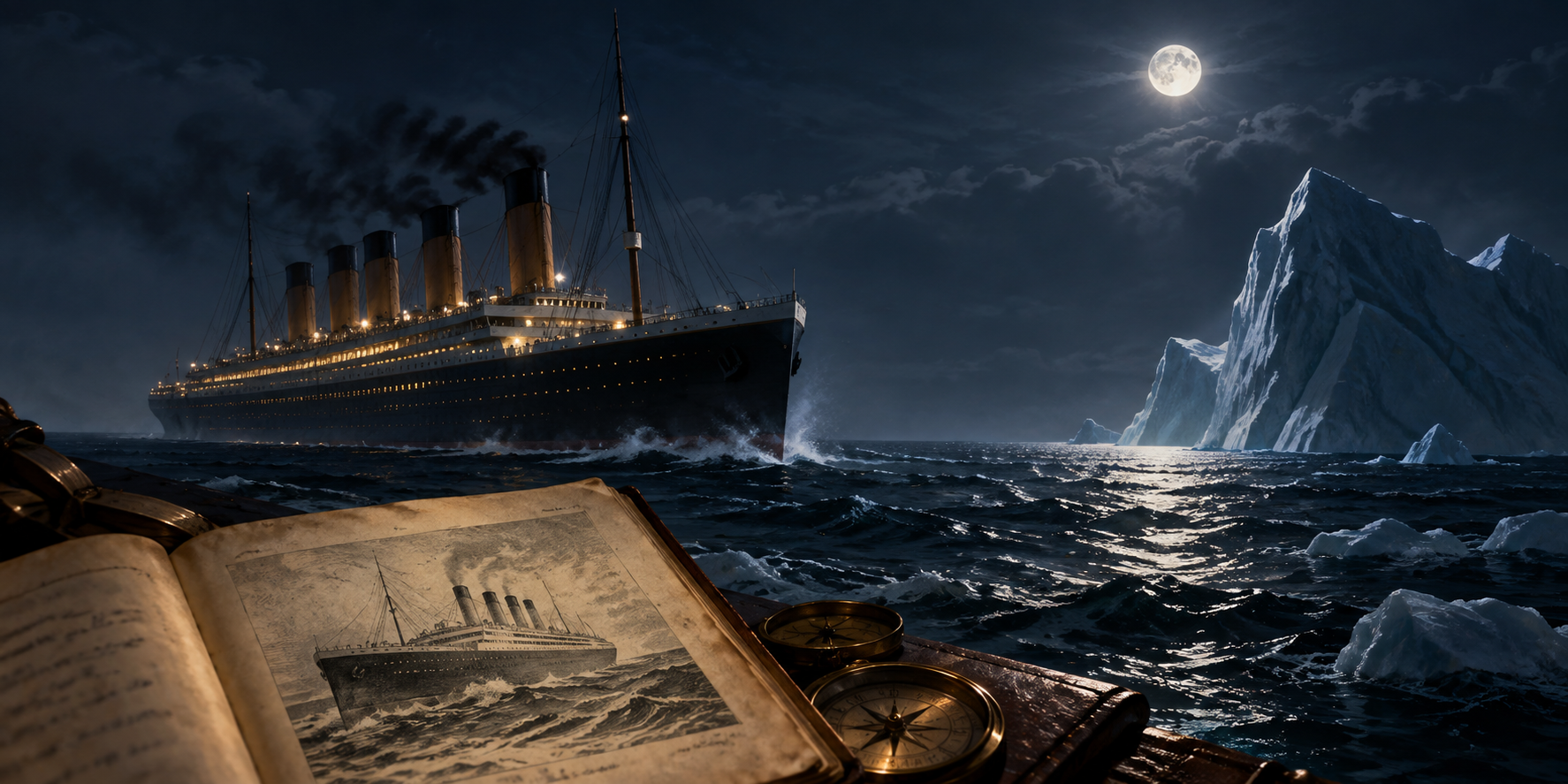
The Titanic
When Fiction Came Too Close to the Truth
In 1898, fourteen years before RMS Titanic sailed into history, an American author named Morgan Robertson wrote a story about the loss of a vast passenger liner in the North Atlantic.
It was one of the largest ships afloat. It was considered practically unsinkable. It struck an iceberg in April and there were nowhere near enough lifeboats for everyone aboard.
Robertson called his fictional ship Titan.
Fourteen years later, Titanic sailed.
Coincidence?
Almost certainly.
But it is a remarkably uncomfortable one.
The Ship That Existed Before Titanic
Morgan Robertson's Futility, later published as The Wreck of the Titan, appeared in 1898.
His fictional Titan was a technological wonder, an enormous ocean liner described as the greatest achievement of mankind. Robertson imagined a ship so large, powerful and apparently safe that catastrophe seemed almost inconceivable.
Then he sent her into the North Atlantic.
In April.
Towards an iceberg.
And when disaster came, there were insufficient lifeboats for those aboard.
There are plenty of exaggerated claims on the internet about just how closely Robertson "predicted" Titanic. Some comparisons use details from later editions of his story, including a version published after the Titanic disaster.
We don't need those embellishments.
The similarities that genuinely existed are extraordinary enough.
Robertson's story appeared fourteen years before Titanic sank. His Titan was a huge liner, regarded as unsinkable, crossing the North Atlantic when she encountered an iceberg in April. The resulting loss of life was made considerably worse by inadequate lifeboat provision.
On the night of 14 April 1912, Titanic struck ice in the North Atlantic. She foundered in the early hours of the following morning. The subsequent American investigation examined, among other things, the inadequate number of lifeboats carried aboard her.
But Robertson wasn't the only writer whose fiction would later acquire an eerie connection with Titanic.
There was another.
And this time the author himself would become part of the story.
The Man Who Wrote His Own Warning
William Thomas Stead was one of the best-known British journalists of his age.
In 1886, Stead published a fictional account entitled How the Mail Steamer Went Down in Mid Atlantic, by a Survivor.
His imaginary disaster was not caused by an iceberg. The steamer collided with another vessel.
But that wasn't really Stead's point.
His concern was what happened afterwards.
There were not enough lifeboats.
People died because of it.
Stead was so concerned about the danger that he appended an editorial warning to the story. This, he said, was the sort of disaster that could happen if passenger liners continued going to sea without enough boats.
Six years later, in 1892, Stead returned to the subject of maritime disaster.
This time his story, From the Old World to the New, featured the White Star Line's Majestic. During the story, survivors are discovered after another vessel encounters an iceberg in the North Atlantic.
Then came 1912.
Stead booked a first-class passage aboard another White Star Line vessel.
Her name was Titanic.
He did not survive.
Suddenly, stories written decades earlier no longer looked quite so comfortable.
Did Fiction Predict Titanic?
Probably not.
Morgan Robertson knew ships and understood the direction in which ocean-liner design was heading. Ships were becoming larger and faster. The North Atlantic was already a well-established route, ice was a known danger and lifeboat provision was a genuine safety issue.
Stead wasn't peering supernaturally into the future either.
He was warning his readers about a danger he believed already existed.
And perhaps that's the more interesting explanation.
Neither man needed to predict the future.
They simply needed to understand the present.
Sometimes fiction takes the world as it exists, moves one or two pieces around and asks the simplest question a writer possesses:
What if?
Occasionally, history provides the answer.
When History Meets Fiction Again
That strange boundary between real history and imagined lives fascinated me when I wrote The Brittle Sea.
I didn't want to rewrite the story of Titanic. History doesn't need my help.
Instead, Titanic became a doorway.
A fictional young woman named Magda Asparov boards the ship.
Then history intervenes.
The ship strikes an iceberg.
Magda is rescued by the last ship to reach the disaster area, The Lady Jane. Magda has lost her memory and doesn't remember she is travelling to America to meet and marry Matthew Turner, an ambitious and treacherous New York businessman.
From that moment, the fictional lives are forced to exist within the consequences of a very real event.
That is one of the peculiar freedoms of historical fiction. We cannot change what happened.
But we can ask what might have happened to people who were never recorded by history because they existed only in the imagination.
Morgan Robertson imagined a ship called Titan fourteen years before Titanic.
W. T. Stead imagined disasters at sea, warned about inadequate lifeboats, wrote about an iceberg collision and eventually boarded Titanic himself.
Neither man needed supernatural powers.
Perhaps fiction doesn't predict the future at all.
Perhaps occasionally it simply notices where the present is heading before the rest of us do.
Written by Tom Kane.
Copyright © Brittle Media Ltd 2026
Published by Brittle Media Ltd
Read about my trilogy, The Brittle Saga. Click here - https://www.fictionbooks.online/e-book-series/brittle-saga/